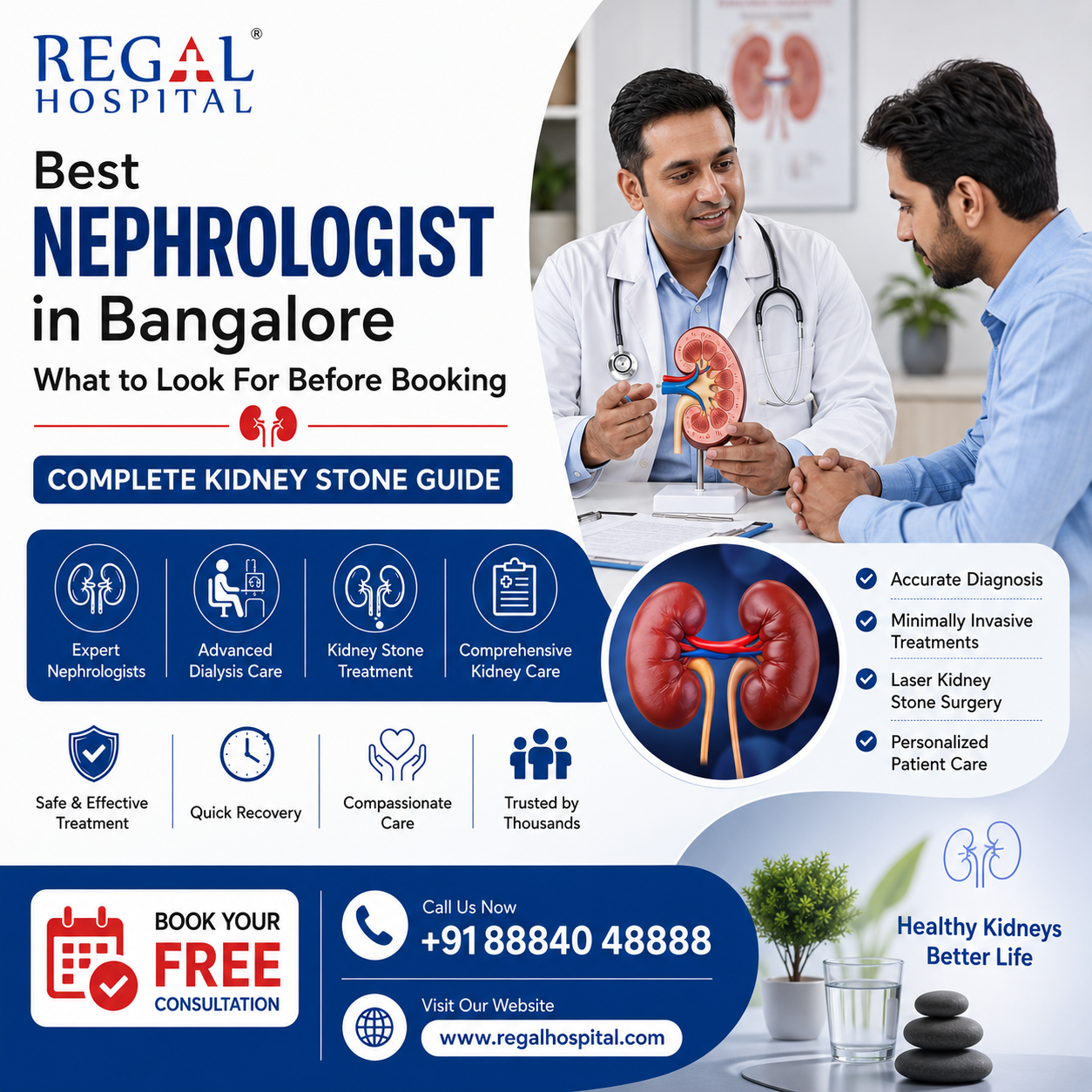
First, your kidneys play a vital role in filtering dangerous waste from your blood. Additionally, they balance body fluids to maintain your health continuously. When critical issues arise concerning your urinary system, you must act fast. Specifically, you should consult a qualified specialist to protect your long-term health.
Undoubtedly, your choice of doctor depends heavily on your specific illness. If you face severe kidney issues, you need an advanced facility. Therefore, choose the best kidney stone hospital in bangalore to access complete urological care. Before booking, ensure the clinic has an independent dialysis section and expert teams.
Fortunately, Regal Hospital is a leading institution for treating renal diseases. One of the most frequent and painful ailments we treat is kidney stones. Therefore, for those looking to resolve stone issues, building a clear understanding is the first step.
What Are Kidney Stones?
Basically, kidney stones are hard deposits of crystal-like substances that form inside the kidneys. This painful condition occurs when your urine contains high concentrations of minerals. Specifically, substances like calcium, oxalate, and uric acid crystallize quickly.
Interestingly, kidney stones vary heavily in size. For instance, some are as small as a grain of sand. Consequently, they pass through the urinary tract completely unnoticed. Conversely, others grow large enough to cause severe blockages in the ureters.
Common Symptoms of Kidney Stones
While a stone sitting silently inside the kidney causes no discomfort, movement triggers immediate signs. Specifically, common symptoms include:
-
Severe Pain: First, sharp and intense pain below the ribs in your back.
-
Radiating Pain: Next, sharp pain that travels down to the lower abdomen.
-
Fluctuating Waves: Also, painful spasms that cause varying levels of discomfort.
-
Burning Urination: Furthermore, experiencing a sharp stinging or burning sensation.
-
Discolored Urine: Additionally, urine that appears red, pink, or cloudy.
-
Urgency: Finally, an increased frequency of urination with very small volumes.
When Stone Pain Becomes Serious
Usually, small stones are managed safely at home with proper guidance. However, certain emergency symptoms require immediate clinical evaluation:
-
First, pain so severe that you cannot sit still.
-
Next, high fever and chills, which indicate a dangerous infection.
-
Also, persistent nausea accompanied by severe vomiting.
-
Finally, an absolute, sudden inability to urinate at all.
Causes and Risk Factors
Generally, several contributors cause minerals to crystallize in the kidneys:
-
Dehydration: First, not drinking an adequate amount of water daily.
-
Poor Diet: Next, eating foods high in sodium, sugar, and heavy animal proteins.
-
Genetic Factors: Also, a positive family history increases your risk naturally.
-
Obesity: Finally, high body weight correlates heavily with stone formation.
Means of Diagnosis
To determine the most effective treatment, your physician must identify the stone precisely. At Regal Hospital, our diagnostics are fast and precise:
-
Diagnostic Imaging: First, high-resolution ultrasound or CT scans locate the stone instantly.
-
Blood Tests: Next, lab tests evaluate overall kidney function and uric acid levels.
-
Urine Tests: Finally, a 24-hour test checks for stone-forming minerals safely.
Advanced Kidney Stone Treatments
Currently, our treatment options vary with stone size and symptom severity:
1. Medication and Lifestyle Changes
First, most small stones pass without any surgical intervention. In this instance, your doctor recommends drinking 3 liters of water daily. Also, we use alpha-blockers to relax the ureter for easier passage.
2. ESWL Lithotripsy
Next, ESWL is the ideal choice for medium-sized stones. Specifically, this non-invasive technique uses external sound waves to shatter stones into fine particles.
3. Ureteroscopy and Laser Surgery
Furthermore, if a stone remains stuck, a less invasive surgical option is available. Basically, a surgeon passes a thin camera through the urethra with zero incisions. Then, the stone is broken to dust using a precision laser for rapid recovery.
4. PCNL Surgery
Category, PCNL is the preferred method for removing large, complex stones. Specifically, a urologist removes the stone through a tiny incision in your back.
Recovery and Prevention Tips
Ultimately, protecting your kidney health means preventing additional stones from forming. Therefore, follow these strategic tips:
-
Stay Hydrated: First, drink enough water to keep your urine pale.
-
Reduce Sodium: Next, cut out salty foods to lower calcium excretion.
-
Eat Dietary Calcium: Also, dietary calcium binds oxalates safely in your stomach.
-
Limit Red Meat: Finally, reduce animal protein to prevent uric acid stones.
Why Choose Regal Hospital?
In conclusion, resolving kidney issues requires advanced technology and dedicated expertise. Conveniently located near Yelahanka, Hebbal, and Thanisandra, we offer comprehensive care under one roof. From diagnosis to advanced laser treatments, our specialists protect your health fully. Furthermore, our patient care communication is developed by the best digital marketing agency to keep families informed.
📞 Call us today: +91 888 405 8888
📍 Visit us: Near Thanisandra-Yelahanka Road, Bengaluru
🌐 Learn more: www.regalhospital.com