First, imagine going for a routine health check-up. When your ultrasound report arrives, your eyes immediately lock onto the words “renal cyst.” For most people, seeing any kind of growth mentioned triggers instant anxiety. Naturally, it is completely normal to wonder if it is cancer.
If you are experiencing this right now, please take a deep breath. Truly, finding a kidney cyst is incredibly common today. Furthermore, the vast majority of the time, it is entirely harmless. In fact, many people walk around with kidney cysts without ever knowing!
Here at Regal Hospital, we see patients with this exact worry every single week. Because we believe clear information is the best remedy for anxiety, we are here to help. Therefore, here is an easy guide explaining kidney cysts and what your next steps should be.
What Exactly is a Kidney Cyst?
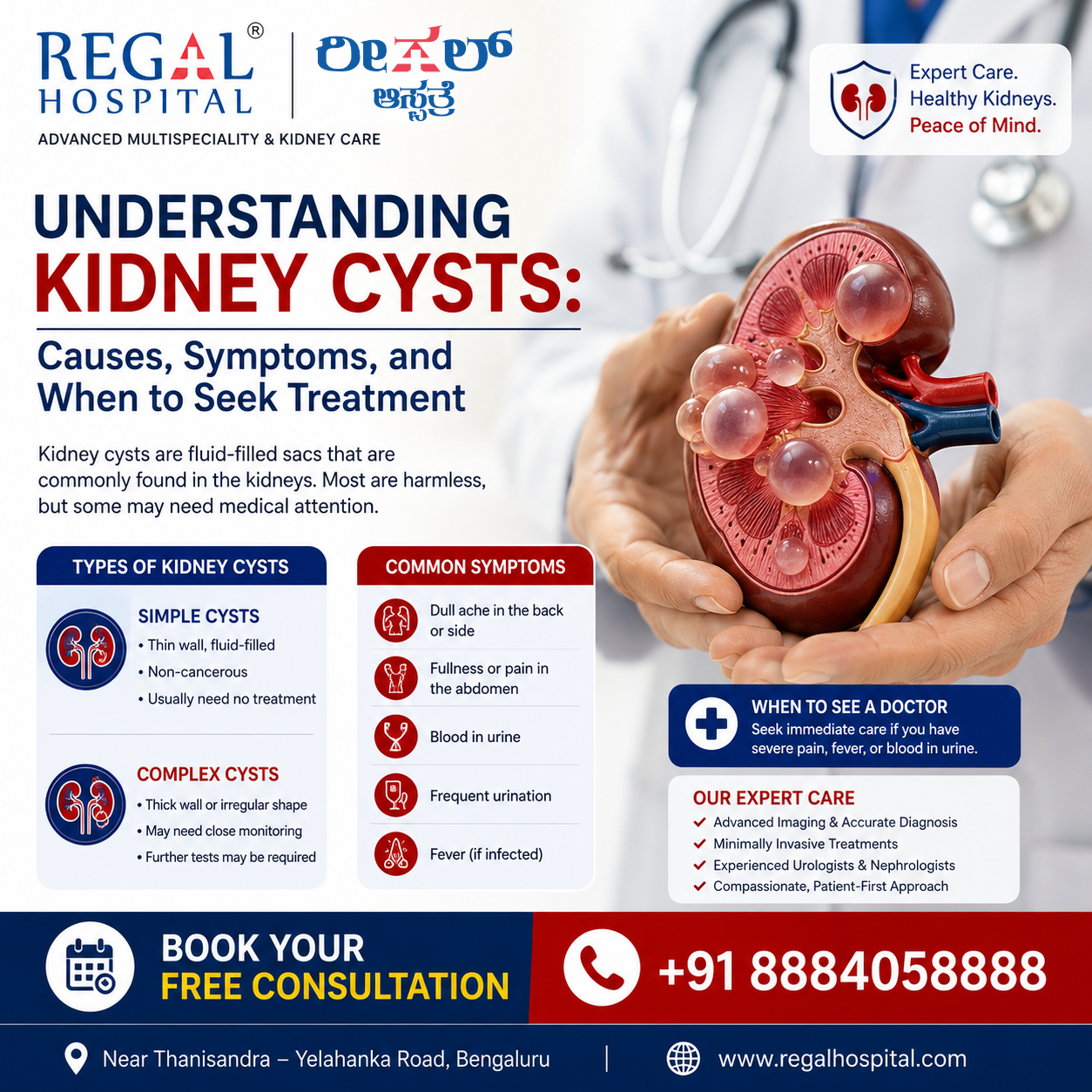
Basically, a kidney cyst is a small, round pouch filled with fluid. Specifically, it forms either on or completely inside the kidney. To picture it, imagine a tiny water balloon resting gently on your kidney’s surface.
Interestingly, kidney cysts range heavily in size. For example, some are tiny like a pea. Conversely, others slowly grow to the size of a golf ball. Also, a person might have just one solitary cyst, or several on both kidneys safely.
The Two Main Types of Kidney Cysts
When you consult a urologist with your ultrasound report, they check the cyst type first. Generally, cysts are divided into two main categories:
1. Simple Kidney Cysts (The Harmless Kind)
First, simple cysts are by far the most common type you will see. Specifically, they have a very thin, smooth outer wall filled with clear fluid. Most importantly, they are almost always non-cancerous.
-
Why they form: While the exact reason is unknown, they are a normal part of aging. By age 50, nearly half of all people have at least one simple kidney cyst.
-
Do they cause problems? Fortunately, most simple cysts cause absolutely no symptoms. Usually, your doctor simply monitors it during your annual check-up safely.
2. Complex Kidney Cysts (The Kind to Monitor)
Next, a complex cyst looks completely different on an ultrasound scan. Instead of a smooth wall, it might have irregular borders or solid tissue inside.
-
Do they cause problems? While many complex cysts are still harmless, they require much closer attention. Because kidney cancer sometimes looks like a complex cyst, your doctor will order advanced imaging tests immediately.
Polycystic Kidney Disease (PKD): A Different Condition
Crucially, it is important to distinguish simple cysts from Polycystic Kidney Disease (PKD).
While simple cysts usually number just one or two, PKD causes massive clusters. Over time, these clusters enlarge the kidneys significantly. Consequently, they reduce filtering ability, eventually causing Chronic Kidney Disease. Because PKD is an inherited genetic condition, it requires specialized, long-term medical care.
Warning Signs: Symptoms You Should Not Ignore
As mentioned, most simple cysts never cause any symptoms at all. However, if a cyst grows large enough to press on other organs, you may experience:
-
A Dull Ache: First, lingering pain in your back or side, usually between the ribs.
-
Upper Abdomen Pain: Next, a heavy feeling of fullness or pain in your stomach area.
-
Fever and Chills: Also, if the fluid inside the cyst becomes infected, you will get a fever.
-
Changes in Urination: Finally, needing to visit the washroom more often, or noticing blood in your urine.
When to Seek Immediate Help: If you experience sudden, unbearable back pain with a fever, do not wait. This means a cyst has ruptured and requires emergency care immediately.
How Are Kidney Cysts Treated?
Fortunately, the treatment plan depends entirely on the size of the cyst safely.
-
Watchful Waiting: First, if you have a small, symptom-free cyst, you need no treatment. We simply perform a yearly ultrasound.
-
Draining the Cyst: Next, if a cyst causes pain, a doctor can drain it using local anesthesia. Then, the empty sac is filled with a special alcohol solution to prevent regrowth.
-
Minimally Invasive Surgery: Finally, for very large cysts, a surgeon uses tiny incisions and a camera. This safely removes the cyst wall with a very quick recovery time.
Practical Tips for Patients and Families
Ultimately, protecting your kidney health at home is incredibly easy. Therefore, follow these practical tips:
-
Don’t Panic: First, remember discovering a simple cyst is just like finding a gray hair.
-
Stay Hydrated: Next, drink plenty of water to prevent complicated kidney stones.
-
Control Blood Pressure: Also, high blood pressure puts extra, dangerous strain on your kidneys.
-
Avoid Contact Sports: Furthermore, if you have a massive cyst, avoid wrestling or football completely.
-
Keep Appointments: Finally, never skip your yearly ultrasound check-up safely.
Get Peace of Mind for Your Kidney Health Today
In conclusion, dealing with medical uncertainty is stressful. However, you are completely safe at Regal Hospital. Conveniently located near Thanisandra-Yelahanka Road, we provide expert kidney care.
Specifically, our advanced Urology and Nephrology departments accurately distinguish between harmless and complex cysts. Therefore, our doctors take the time to explain everything clearly. Do not let worry disrupt your life today.
📞 Call us today: +91 888 405 8888
📍 Visit us: Near Thanisandra-Yelahanka Road, Bengaluru
🌐 Learn more: www.regalhospital.com