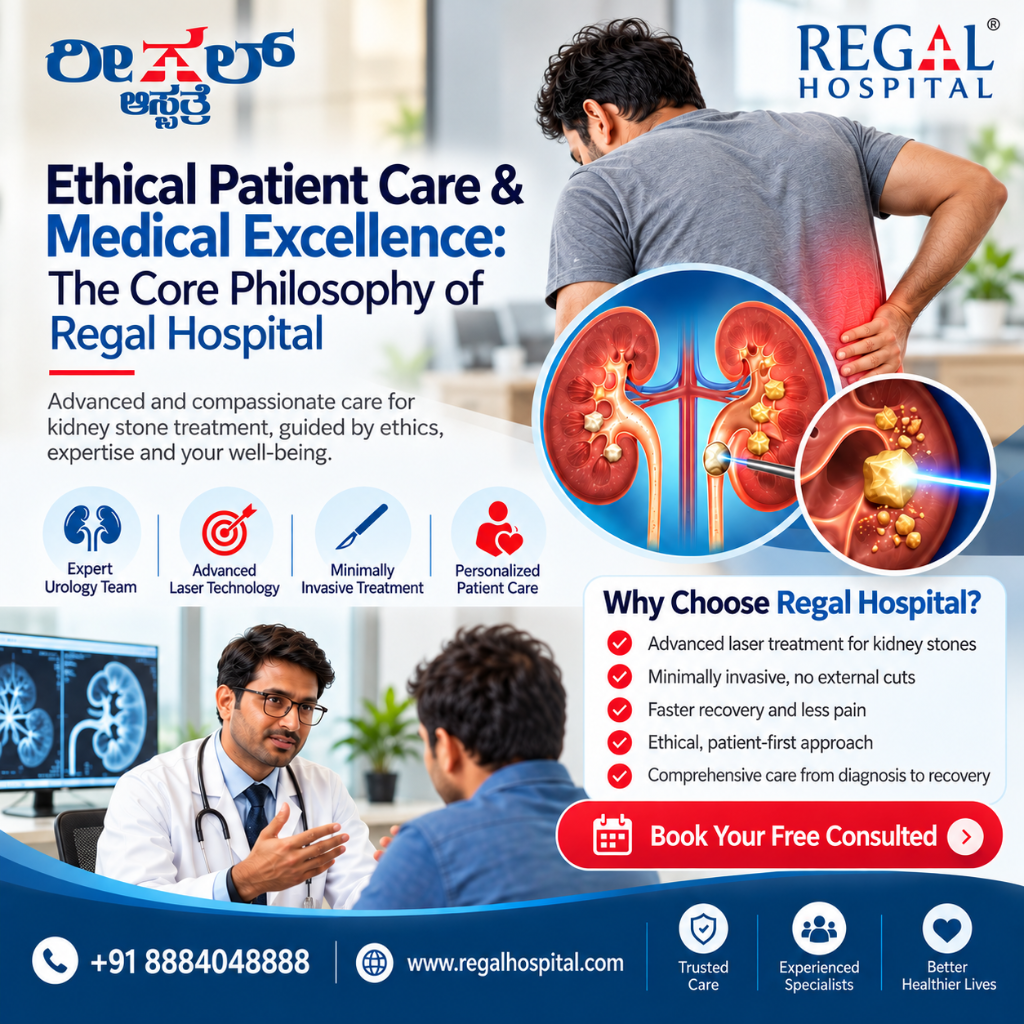
Introduction:
Kidney stones can cause sudden, intense pain and may leave patients wondering whether they need medication, a procedure, or urgent medical attention. Understanding the symptoms, causes, diagnosis, and available treatment options can help patients make informed decisions about their care.
For families looking for ethical healthcare in Bangalore, access to clear information and appropriate medical advice is an important part of the treatment journey. Regal Hospital is a multispecialty and advanced kidney care hospital serving patients in North Bangalore and surrounding areas, including Thanisandra, Hennur, Yelahanka, Hebbal, and Tirumanahalli.
With urology, nephrology, diagnostic, emergency, and surgical services, Regal Hospital focuses on evaluating each patient’s condition before recommending an appropriate treatment approach.
What Are Kidney Stones?
Kidney stones are hard, pebble-like deposits that form when certain minerals and substances become concentrated in the urine and form crystals. They may develop in one or both kidneys and can vary considerably in size. Some small stones pass naturally without causing noticeable symptoms, while larger stones can obstruct the urinary tract and cause significant pain.
The most common stones are calcium stones, while uric acid, struvite, and cystine stones are other types. The type of stone and its size and location can influence the treatment plan.
Common Kidney Stone Symptoms
Kidney stone symptoms can vary depending on the stone’s size and where it is located.
Common symptoms include:
Sharp or severe pain in the side, back, lower abdomen, or groin
Pain that comes and goes in waves
Blood in the urine, which may make urine appear pink, red, or brown
Pain or burning while urinating
Frequent or persistent urge to urinate
Nausea or vomiting
Cloudy or foul-smelling urine
Difficulty passing urine or passing only a small amount
Fever or chills, particularly when an infection is also present
These symptoms do not always mean that a person has a kidney stone. Similar symptoms can occur with urinary infections and other urinary conditions, so medical evaluation is important.
What Causes Kidney Stones?
Kidney stones can develop for several reasons. Dehydration and concentrated urine are important contributors, but diet, family history, certain medical conditions, urinary obstruction, and previous kidney stones can also increase risk.
Common risk factors risk may be higher if you:
Do not drink enough fluids
Have previously had kidney stones
Have a family history of stones
Consume a diet high in sodium
Have certain metabolic or digestive conditions
Have urinary tract obstruction
Consume high amounts of animal protein in some circumstances
Have certain inherited conditions that make stones more likely
Because the cause can differ from one patient to another, prevention advice should ideally be personalised by a doctor.
When Does Kidney Stone Pain Become Urgent?
Not every kidney stone requires emergency treatment, but certain symptoms should not be ignored.
Seek urgent medical attention if kidney stone symptoms are accompanied by:
Severe or worsening pain
Fever, chills, or feeling unusually unwell
Persistent vomiting or inability to keep fluids down
Blood in the urine
Inability to pass urine or a significant reduction in urine
Pain together with symptoms suggesting a urinary infection.
A blocked urinary tract combined with infection can require prompt medical treatment.
If you are experiencing severe pain with fever, vomiting, urinary difficulty, or infection symptoms, do not rely on home remedies alone. Seek an emergency or urgent medical assessment.
How Are Kidney Stones Diagnosed?
A urologist usually considers your symptoms, medical history, physical examination, and test results before confirming the diagnosis.
Depending on the situation, evaluation may include:
Urine tests: These can help identify blood, infection, or other abnormalities.
Blood tests: These may help assess kidney function and identify certain factors associated with stone formation.
Ultrasound: An imaging test that can help identify stones or urinary obstruction.
CT scan: In appropriate patients, CT imaging can provide detailed information about the stone’s size and location.
Regal Hospital’s facilities include diagnostic services such as CT, ultrasound, X-ray, and Doppler imaging, supporting the assessment of urological and kidney-related conditions.
Kidney Stone Treatment in Bangalore: What Are the Options?
The right kidney stone treatment in Bangalore depends on factors such as stone size, location, symptoms, obstruction, infection, overall health, and whether the stone is likely to pass naturally.
Medicines and Observation
Some smaller stones may pass naturally. A doctor may recommend observation, adequate fluids where medically appropriate, pain relief, and medicines that can help manage symptoms or facilitate passage in selected patients.
Do not start prescription medicines on your own. The choice of medicine depends on your individual medical history and diagnosis.
Lifestyle and Fluid Advice
Drinking enough water is an important part of preventing many kidney stones. However, fluid recommendations may need to be modified for people with kidney failure, certain heart conditions, or other medical problems.
Depending on the type of stone, a healthcare professional may also recommend reducing excess sodium, moderating certain animal proteins, and maintaining appropriate dietary calcium rather than unnecessarily eliminating calcium from the diet.
ESWL
Extracorporeal Shock Wave Lithotripsy (ESWL) uses shock waves to break selected kidney or ureter stones into smaller fragments that can then pass through the urinary tract.
Regal Hospital provides ESWL treatment, and its urology department lists lithotripsy among its minimally invasive stone-treatment options. Whether ESWL is appropriate depends on factors such as the stone’s size, location, and characteristics.
Ureteroscopy and Laser Treatment
During ureteroscopy, a small scope is passed through the urinary tract to reach the stone. The stone may be removed or broken into smaller fragments.
Laser technology can be used to fragment stones during ureteroscopy. Regal Hospital’s urology department also lists laser procedures and retrograde intrarenal surgery (RIRS) among its treatment options.
Surgery for Larger or Complex Stones
Some larger, complex, or difficult-to-treat stones may require a surgical approach.
Percutaneous nephrolithotomy (PCNL) is one option for selected larger kidney stones. It involves accessing the kidney through a small opening in the back to break and remove the stone. Regal Hospital lists PCNL among its urological procedures.
Therefore, kidney stone treatment in Bangalore should not be selected based on the procedure name alone. A urologist should assess the individual patient before recommending ESWL, ureteroscopy, laser treatment, PCNL, medication, or observation.
Recovery and Prevention After Kidney Stone Treatment
Recovery depends on the treatment performed and the individual patient’s health.
After treatment, your doctor may advise you to:
Drink adequate fluids unless medically restricted.
Take prescribed medicines exactly as directed.
Follow post-procedure activity and dietary instructions.
Attend recommended follow-up appointments.
Ask whether the stone should be analysed.
Discuss preventive testing if stones recur.
Prevention is particularly important because having one kidney stone can increase the likelihood of developing another. Depending on the stone type, dietary changes may involve fluid intake, sodium, animal protein, calcium, or oxal
Why Choose Regal Hospital for Kidney Stone Treatment in Bangalore?
Choosing a hospital for kidney stone care is about more than the availability of a procedure. Patients and families also need clear communication, appropriate diagnosis, access to specialists, and a care environment that respects individual needs.
Regal Hospital is an advanced kidney care and multispecialty hospital in Tirumanahalli, Bengaluru, near the Thanisandra-Yelahanka Road corridor. Its services include urology, nephrology, dialysis, diagnostic imaging, ICU care, and surgical facilities.
The hospital’s urology department provides evaluation and treatment for kidney stones and other urinary conditions, including ureteroscopy, ESWL, laser procedures, RIRS, and PCNL.
For people searching for a patient centric hospital in Thanisandra or a urology hospital in Bangalore, proximity can also make specialist consultation and follow-up more accessible. Regal Hospital is located in Tirumanahalli and serves patients from North Bangalore and nearby areas.
Frequently Asked Questions About Kidney Stones
- What are the most common symptoms of kidney stones?
Common symptoms include sharp pain in the back, side, lower abdomen, or groin; blood in the urine; painful or frequent urination; nausea; vomiting; and, in some cases, fever or chills.
- Can a kidney stone pass without surgery?
Yes. Some smaller stones may pass naturally, depending on their size and location. A doctor may recommend observation, medicines, fluids, and pain management where appropriate. Larger or obstructing stones may require a procedure. NNIDDK
- Is ESWL suitable for every kidney stone?
No. ESWL is not appropriate for every patient or every stone. A urologist considers factors such as the stone’s size, location, composition, and the patient’s overall health before recommending it.
- When should I see a urologist for kidney stone symptoms?
You should consult a urologist for persistent or recurring stone symptoms, blood in the urine, painful urination, suspected stones, or recurrent urinary problems. Severe pain, fever, vomiting, inability to pass urine, or infection symptoms require urgent medical assessment.
- How can I reduce my risk of getting kidney stones again?
Adequate fluid intake is one of the most important preventive measures for many people. Depending on your stone type, your doctor may also recommend dietary changes involving sodium, animal protein, calcium, or oxalate. Individual advice is preferable because prevention depends on why the stone formed.
Book Your Free Consultation Today
Book Your Free Consultation Today
 Call us today: +91 888 405 8888.
 Visit us: Near Thanisandra-Yelahanka Road, Bengaluru
 Learn more: www.regalhospital.com