Introduction:
Complex fractures impact movement and can also impact employment, daily activities, and independence. Fractures that also involve a joint may result from falls on outstretched arms or an injury from another source. Treatment for this type of fracture should be individually tailored to the specific injury to restore as much function as possible
Patients searching for an orthopedic surgeon Bangalore should understand how complex fractures are assessed and treated to help make informed decisions regarding their care. The treatment for a complex fracture may require immobilization, surgical fixation or joint reconstruction, or rehabilitation.
Regal Hospital in North Bangalore provides assessment and treatment for complex fractures and other related conditions. The hospital is in Tirumanahalli and is convenient for patients living in Thanisandra, Hennur, Yelahanka, Hebbal, and surrounding areas.
Patients will find information about complex fractures, the role of an orthopedic surgeon, available treatment options, and what to expect during the healing process.
Fractures with soft tissue injury: In addition to the bone, injury to soft tissue (i.e. muscle, tendon, nerve or vessel) can occur.
These types of injuries occur with high energy events, i.e. road traffic accidents, falls from height, high energy sports injuries, etc. Other fractures, in the elderly for example, may occur from relatively low energy injuries due to osteoporosis.
Why Precision Matters in Complex Fracture Treatment
The overall goal of fracture treatment is to help the bone heal in the correct position and to minimize the risk of complications to surrounding structures. Treatment may consist of either non-operative (i.e. immobilization) or operative (i.e. alignment of the bone or stabilization with a device) management, or both.
Prior to making a recommendation for treatment, an orthopaedic surgeon will consider the following:
- The location and pattern of the fracture.
- The degree of displacement and bone fragmentation.
- Whether the fracture involves a joint.
- The condition of the soft tissues and skin.
- Blood supply and nerve function.
- The patient’s age, health and activity level.
An injury to a joint, for example, may permanently compromise joint function. It may be crucial to realign the joint to protect joint function. Applying this principle to all joints, and considering all the factors above, may impact the overall approach to treatment.
It is important for patients to understand their injury, the treatment options available, the expected recovery and the potential complications. Patients seeking an orthopaedic surgeon in Bangalore should seek a review where these factors are discussed.
How Are Complex Fractures Diagnosed?
For the orthopaedic surgeon to accurately diagnose a complex fracture, the following are evaluated:
– A thorough physical exam to determine swelling, pain and deformity
– Whether the surrounding tissues are injured (i.e. damage to nerves and/or blood vessels)
– The patient’s medical history and general health
– The type of activity the patient participates in
In addition to the above, imaging studies (X-ray or CT scan) may be ordered to further assess the injury.
- X-rays
X-rays are used to locate and determine the nature of a bone fracture. They help to determine the degree of displacement, if any, of the fractured bone.
- CT-scans and Other Imaging
Complex fractures of the hip, pelvis and ankle, as well as fractures of joint surfaces, are sometimes evaluated using a CT scan. Information provided by a CT scan may help determine the exact position of bone fragments in a complex fracture.
Further imaging may be required to evaluate the injuries of ligaments, tendons and other soft tissues.
Regal Hospital has listed orthopaedic X-ray and diagnostic imaging services at its facilities. The type and number of tests required depend on the injury and the clinician’s assessment.
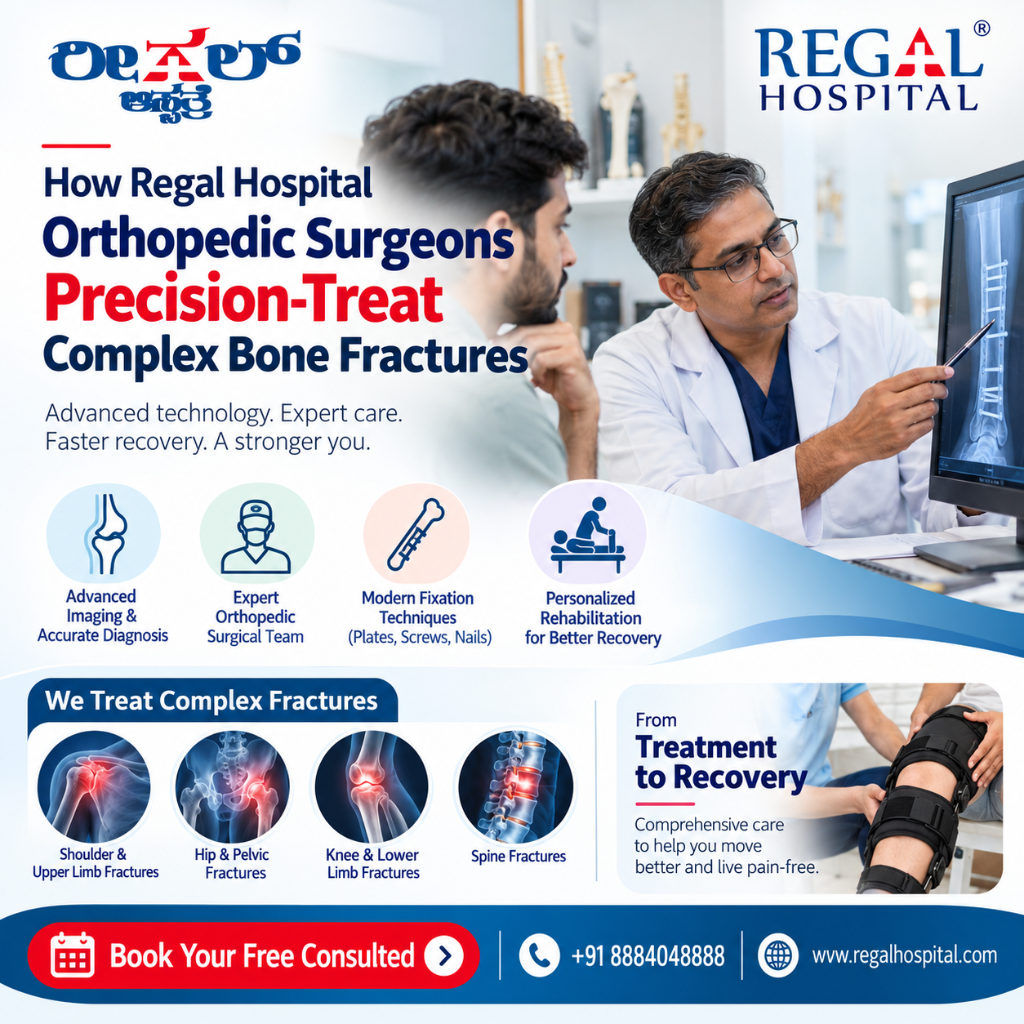
Treatment Options for Complex Bone Fractures
Not all complex fractures require surgery. The treatment plan and options depend on the fracture pattern and the stability of the fracture and surrounding soft tissues, as well as the health of the patient.
- Immobilisation and Non-Surgical Treatment
In some cases, the treatment of a fracture may require the use of a splint, brace or other support to keep a fractured bone stabilized until it heals. The treating physician may order a series of X-rays to assess the healing and alignmen of the fracture.
- Open Reduction and Internal Fixation
Open reduction and internal fixation (ORIF) is a surgical procedure in which the fractured bone is repositioned and fixed using an implant.
Based on the fracture, various fixation devices such as plates and screws may be used to maintain the alignment while the fracture heals.
ORIF may be used to treat displaced fractures or fractures involving joints that cannot be treated with other methods.
- Intramedullary Nailing
The technique of placing a metal rod in the central canal of a long bone, like the thigh bone or shin bone, is used to treat selected fractures of long bones.
The decision between rods, plates, screws or other methods depends on factors such as the site of the fracture, its characteristics and the overall condition of the patient.
- External Fixation
An external fixator uses external devices, e.g. frame, with pins or wires inserted into the fractured bone to provide stability to a fractured bone. It can be used in selected cases of severe injuries.
- Joint Reconstruction and Specialist Procedures
Joints involve complex articular (joint surface) structures. For fractures of joints, the articular surfaces may require special fixation. Sometimes, it may require a combination of other procedures for joint reconstruction. The treatment for fractures of joints will depend on age of the patient, quality of the bone, other existing medical conditions, the joints involved, and the overall health of the patient.
An orthopaedic surgeon is in the best position to explain and discuss the various treatment options and the risks and benefits of the proposed surgery.
Early Specialist Assessment can be of help for patients who require a surgical intervention for fracture of a bone in Thanisandra.
Fracture Care after Surgery
Depending on the nature of the fracture, complications, general health and healing, further care may be required after surgery. Possible interventions include monitoring of wound healing, pain management, gradual return to activity and follow-up assessments.
The care team may give suggestions, including:
- Keeping the wound clean and following instructions on wound care.
- Taking prescribed medicines.
- Following restrictions on standing, walking and/or lifting.
- Attending follow-up care appointments and recommended imaging.
- Beginning rehabilitation.
- Adequate nutrition, including intake of calcium and protein.
Healing of bones takes time and injury recovery varies, depending on the fracture and treatment, the person’s general health and any complication. People should not compare their recovery with that of others.
Medical attention should be sought, if there is an increase in pain and/or swelling, or if the operated area becomes red and/or discharge is present, or if a fever occurs, or if the limb becomes pale, numb or weak, or if there is any other change that concerns the person.
Joint Trauma Care at Regal Hospital
Injuries that affect a joint can negatively impact movement and long-term stability and comfort. Treatment may require addressing the bone, as well as surrounding ligaments, tendons and other soft tissues.
Joint trauma care Regal Hospital is an appropriate search phrase for patients looking for orthopaedic services in North Bangalore. Regal Hospital’s orthopaedic department offers services, including fracture care, joint surgery, arthroscopy and others.
Depending on the person’s injury, the orthopaedic team determines the most appropriate treatment, expected recovery and rehabilitation and/or other specialized care that may be required.
Regal Hospital North Bangalore: Fracture Care
The orthopaedics department of Regal Hospital provides services for care and treatment of fractures, joint injuries, various bone and muscle conditions. The treatment options provided by the department includes casting, fracture fixation, joint surgeries, rehabilitation and support.
As Regal hospital north Bangalore is in Tirumanahalli, it is convenient for patients staying in and around north Bangalore such as Thanisandra, Hennur, Yelahanka and Hebbal.
Patients looking for an orthopedic surgeon Bangalore may find it useful to ask the following questions during a consultation:
- What type of fracture do I have?
- Can it heal without surgery?
- What are the benefits and risks of the suggested surgery?
- When can I begin physical therapy and/or put weight on the affected limb?
- How often will follow up visits and X-rays be required?
Regal Hospital has emergency and trauma care facilities as well. A patient with a suspected fracture due to a major injury should be evaluated immediately, especially if there is an open wound, significant limb deformity, severe bleeding, and/or loss of sensation.
Frequently Asked Questions
- What makes a bone fracture complex?
A fracture may be considered complex if the bone breaks into several pieces, becomes significantly displaced, extends into a joint or involves serious damage to surrounding tissues. Imaging and clinical examination help determine the appropriate treatment.
- Do all complex fractures require surgery?
No. Some fractures can be treated with a cast, splint or brace. Surgery may be recommended when the fracture is unstable, significantly displaced or cannot be adequately aligned using non-surgical methods.
- How long does a complex fracture take to heal?
Healing time varies depending on the bone involved, fracture severity, treatment and overall health. Some fractures take several months or longer to recover fully. Your orthopaedic surgeon can provide guidance based on follow-up examinations and imaging.
- When should I seek emergency care for a fracture?
Seek urgent medical attention after a serious injury, particularly if there is an open wound, severe deformity, heavy bleeding, numbness, a cold or pale limb, or rapidly worsening pain. Do not attempt to straighten the bone yourself.
- How can I consult an orthopaedic surgeon at Regal Hospital?
Contact Regal Hospital to enquire about an orthopaedic consultation and appointment availability. If the injury is severe or an emergency, seek immediate emergency care rather than waiting for a routine appointment.
Book Your Free Consultation Today
 Call us today: +91 888 405 8888.
 Visit us: Near Thanisandra-Yelahanka Road, Bengaluru
 Learn more: www.regalhospital.com
This blog is for educational purposes only and should not replace medical advice from a qualified doctor. Please consult a specialist for diagnosis and treatment.