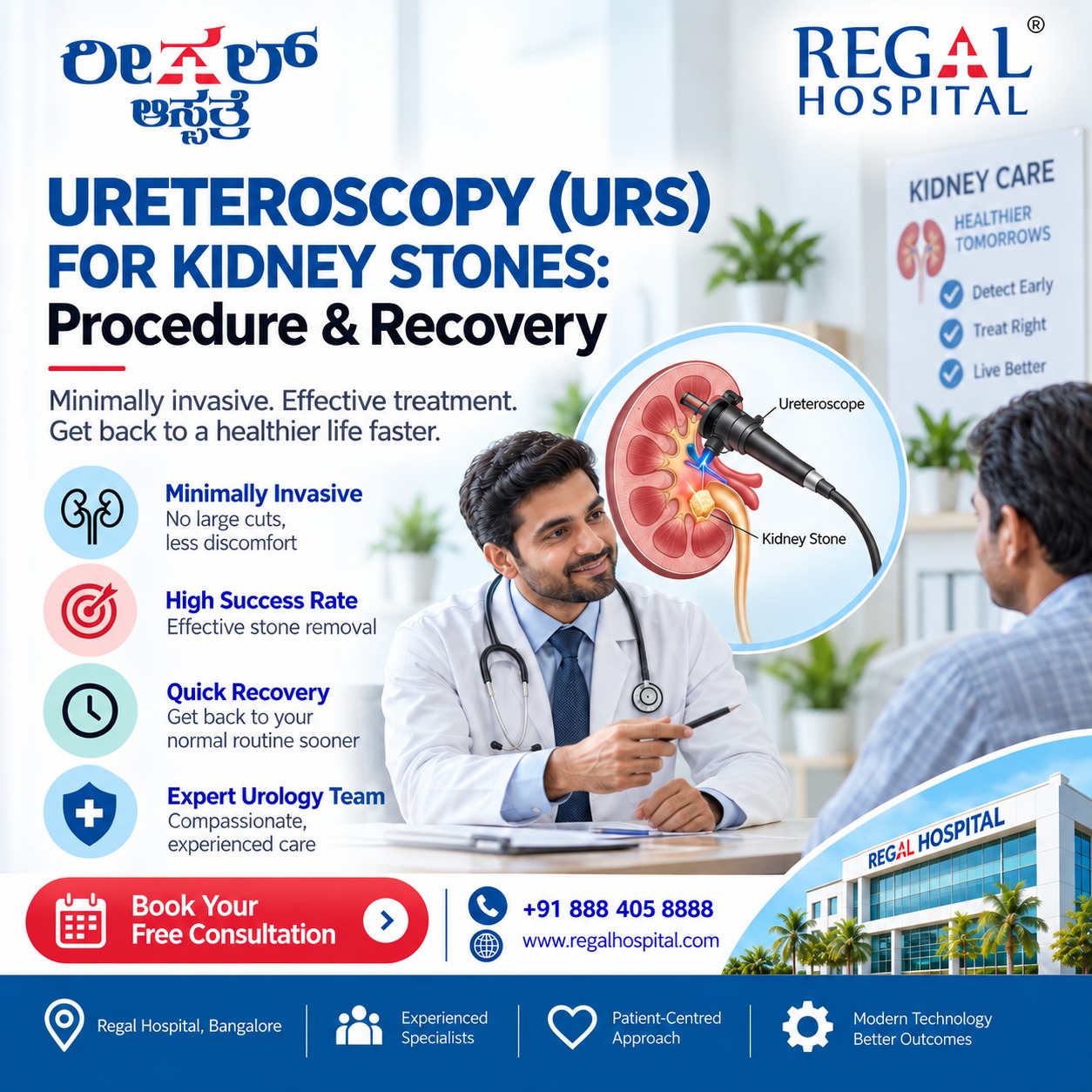
Ureteroscopy (URS) for Kidney Stones
Introduction:
While kidney stones often result in pain, it is more commonly described when a stone moves from the kidney into the ureter. Depending on symptoms and the size and location of a stone, your urologist may opt for ureteroscopy (URS).
Knowing what ureteroscopy is and when it is performed can help you have an effective conversation with your urologist.
Ureteroscopy is a minimally invasive procedure in which a thin scope called a ureteroscope passes through the natural urinary passage in order to reach a stone in the ureter or the kidney. The stone can be removed or broken into smaller pieces with the help of a laser.
The urology team at Regal Hospital welcomes residents of North Bangalore, Thanisandra, Hennur, Yelahanka, Hebbal, Tirumanahalli and the surrounding areas for consultation and treatment of kidney stones.
What are Kidney Stones?
Kidney stones are hard and solid crystalline formations that develop when some substances in urine concentrate and form crystals. Stones can be of all sizes.
Small stones can pass easily through the urinary tract. A medically or surgically created intervention can be performed for stones, which are large, can cause a lot of pain, or block urine.
First, the most appropriate kidney stone treatment in Bangalore will depend on factors like:
Size, number and location of stones
Obstruction of urine flow
Pain and other symptoms
Current kidney function
Any presence of infection
Previous stone history
Overall health
A specialist will assess all these elements before deciding on a course of treatment.
The most common symptoms of kidney stones are:
-
Pain in the side of the back, abdomen and groin that comes and goes
-
Burning or discomfort when urinating
-
Frequent need to urinate
-
Blood in the urine
-
Nausea and vomiting
-
Urine that has a unusual odor or looks cloudy
Several of these symptoms can occur with other conditions and urinary infections so a medical assessment is necessary to determine the cause.
Kidney stones can be caused by many things, including:
-
Not drinking enough water to stay hydrated
-
Too much salt in the diet
-
Family history of kidney stones
-
Forming a stone in the kidney before
Certain medical conditions
There are a number of factors that can cause kidney stones and the most important factors depend on the individual.
Lifestyle Factors
Obesity and certain dietary patterns have been shown to increase the likelihood of developing kidney stones. Low fluid intake can also increase the risk.
When Does Kidney Stone Pain Become Urgent?
When it comes to kidney stones, there are some symptoms that warrant prompt evaluation, while other symptoms do not require urgent medical intervention.
For symptoms that warrant urgent medical intervention:
Fever or chills
Severe or worsening pain
Persistent vomiting
Blood in urine
Inability to pass urine
A combination of severe pain and infection can lead to a serious, life threatening, urinary system blockage.
If you have any of these symptoms, do not hesitate to seek emergency medical attention.
How Are Kidney Stones Diagnosed?
Your urologist can perform a complete physical examination, draw on their experience, and order additional tests.
Urine tests
Urine tests can help determine if there is blood or infection, andurine can be used to determine if there is blood in the urine.
Blood tests
Blood tests are able to help determine if there is an infection of the kidney.
Ultrasound
An ultrasound can determine if there are kidney stones.
CT Scan
In some cases, a CT scan is ordered, but only without a contrast dye, as it is considered less risky and can show the size of the kidney stone.
The course of diagnostics is based on your individual case and symptoms.
What Is Ureteroscopy?
Ureteroscopy is used to diagnose and treat stones of the urinary tract in a minimally invasive manner.
A ureteroscope is passed along the ureter and into the kidney to assess and treat stones in the urinary tract, all performed through a minimally invasive procedure.
During the ureteroscopy, a urologist can characterize the stone in order to make an informed choice to either remove the stone piecemeal, or where appropriate, reduce it to smaller size fragments with a laser.
Fragments are removed either by the urologist or if they are small enough, fragments can be allowed to pass spontaneously. The technique is determined by the stone and the doctor’s assessment.
When would URS Be Indicated?
A stone in the ureter which is larger than 6mm is considered hostile, therefore a stone in the ureter of this size qualifies for an otherwise considered medically unnecessary endoscopic treatment.
Additionally, URS is also appropriate for a stone that is greater than 10mm regardless of location.
URS may also be appropriate for a stone that is causing symptoms unless it is likely to pass spontaneously through the urine.
Additionally, if there is urinary obstruction, ureteroscopy is indicated.
Other Treatment Options
There are other options to manage kidney stones that include ureteroscopy.
Drug Therapy and Active Management
If the stone is small and any symptoms are adequately controlled with analgesics and other medications, ureteroscopy may not be medically necessary.
In some patients, small stones may spontaneously pass with conservative treatment including adequate hydration.
Other Treatment Options
Ureteroscopy is one urological management options for other medical modalities of treatment for kidney stones.
Other Treatments for Kidney Stones
One of the non-invasive methods of kidney stone treatment includes extracorporeal shock wave lithotripsy where kidney stones are broken down to smaller sizes by externally generated shock waves.
ESWL may be an option for certain stones based on their size, location, and other factors related to the patient.
URS
URS is an ideal minimally invasive surgery for treating stones that allow the surgeon to directly access the stone to treat it. In some instances, laser fragmentation can be used.
Other Surgeries
Larger or more complex stones may warrant a longer surgery that is more invasive. The type of surgery can vary depending on the stone burden, the anatomy of the kidney, and other medical factors.
Therefore, when seeking treatment for kidney stones in Bangalore, it is advisable to take a specialist’s opinion based on the viability of the advertised minimally invasive procedures rather than a self-diagnosis.
What Is The Procedure For URS?
The procedure will be different for each case based on the above assessment.
Step 1 has the urologist assess the available medical history and imaging and investigate further as needed prior to the surgery.
Step 2 involves anaesthesia to put the patient completely under for the surgery.
Step 3 involves urinary urerteroscope placement.
Step 4 involves either the removal of the stone or the fragmentation of the stone by the surgeon using laser.
Stent placement may be necessary in the healing process and restoration of urinary tract functionality.
Recovery after Ureteroscopy
Recovery will be based on the burden of stone remaining and overall health of patient.
Some patients experience:
Temporary discomfort associated with urination
Frequent urination
Blood in their urine
Bladder discomfort, made worse by the presence of a stent
Make sure to adhere to your urologist’s instructions regarding fluids, activity, medications and follow ups.
If a stent was placed, ask your doctor when the stent will be removed or when you will be returning for a follow up.
Contact your doctor immediately if you start to have severe pain after the procedure or difficulty urinating or if you start to have other concerning symptoms.
Cost of URS in Bangalore
Patients research the cost of URS surgery Bangalore during their initial research regarding ureteroscopy.
It is not accurate to assume a fixed cost for everyone considering the variability in the following factors of a procedure:
The size of the stones
The number of stones
The necessary diagnostic tests
The nature of the procedure
Anaesthesia
The length of stay
The placement and the length of time a stent is required
Any other treatments that will be required
After assessing a patient, a hospital is the only place that can give an accurate cost.
Is URS Truly Non-Invasive Stone Treatment?
It can be said that URS is an invasive procedure that is less invasive in nature when compared to other traditional invasive procedures.
Like any other surgical procedure, URS requires anesthesia and postoperative care in addition to preparation.
After the surgery, treatment and kidney stone recurrence prevention are important.
Depending on your stone type and your medical history, your doctor may advise you to:
Keep an appropriate balance of fluids in your body.
Limit your sodium consumption.
Adjust your diet according to your individual needs.
Maintain your healthy weight.
Regular exercise.
Control your medical condition.
Follow your doctor’s orders for follow up.
Learn the composition of your stones whenever possible.
Be cautious with major diet changes or intense diets without the supervision of a health care professional.
Why Choose Regal Hospital for Kidney Stone Treatment in Bangalore?
Regal Hospital is a multispecialty and advanced kidney care hospital in Bangalore with units for urology, nephrology, dialysis, kidney biopsy, kidney transplant and emergency care along with other specialties.
For patients needing a urology hospital in Bangalore, especially those staying in North Bangalore and its neighborhoods such as Thanisandra, Hennur, Yelahanka, Hebbal, and Tirumanahalli, a specialist can assist in deciding the best stone treatment.
The urology team can decide the stone’s size, location, and its significance, after which the team can suggest a course of observation or ESWL or ureteroscopy or other methods.
If you experience urinary pain repeatedly or you have kidney stones, book an appointment with a urologist for your stone related problems.
Frequently Asked Questions
- What is ureteroscopy for kidney stones?
During this minimally invasive procedure, a scope is passed through the urinary system in order to reach a kidney or stone in the ureter. In this case, the stone can either be broken into smaller fragments or removed.
- Is laser stone removal safe?
Laser stone removal is performed as a part of ureteroscopy in certain types of stones when indicated. As with any procedure, there are certain potential risks associated with this procedure, which your urologist will inform you of.
- How long does recovery take after URS?
There is no specific time frame as recovery can vary from patient to patient depending on the stone and the procedure. Most patients are able to return to normal activities under the instruction of their doctor.
- Is ureteroscopy better than ESWL?
Neither of these procedures is universally the best. A number of factors influence a selection including size of the stone, location, and the composition of the stone as well as the overall health and symptoms of the patient. A kidney stone specialist is able to make a informed choice for the patient.
- What should I do if kidney stone pain occurs with fever?
Pain from a kidney stone with fever indicates a blockage has created a urinary system infection which is a serious medical issue and warrants immediate care. Seek care over an urgent basis rather than go through the process of scheduling an appointment.
Link to Laser Kidney Stone Treatment Page
Sometimes kidney stones are small and will pass naturally on their own, but other stones will require active intervention. Ureteroscopy is used to get access to targeted kidney stones and performs laser stone fragmentation with minimally invasive techniques.
The correct kidney stone treatment in Bangalore is dictated by your complete medical profile and your doctor’s clinical assessment. A qualified urologist can help you decide between observation, medication, lithotripsy, ureteroscopy, or other options.
This blog is informational in nature and should not be used as a replacement for seeing a doctor. Please make an appointment with a doctor to decide on the course of your treatment.
Book an Appointment with Regal Hospital
 Call us today: +91 888 405 8888
 Visit us: Near Thanisandra-Yelahanka Road, Bengaluru
 Learn more: www.regalhospital.com
For chronic urinary pain or suspected symptoms of a kidney stone, Book an Appointment with Regal Hospital’s urology team in Bangalore.