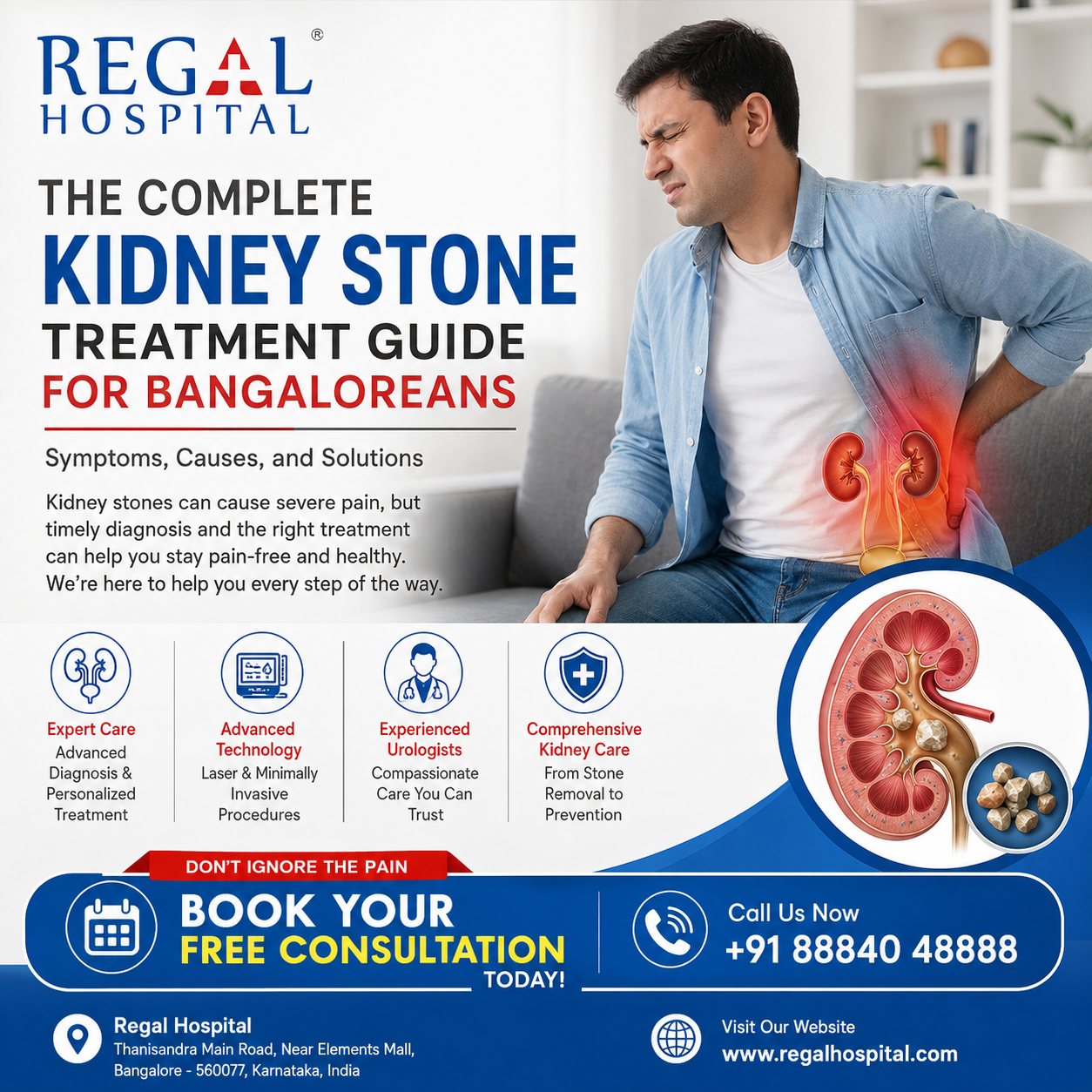
First, the sudden, debilitating pain from a kidney stone attack is a total nightmare. Though a common urological issue causes intense discomfort, treatment is actually very easy today. Specifically, after a timely medical intervention, stones can be safely removed. Consequently, you can resume your daily activities quickly.
Undoubtedly, the first step for patients in Bangalore is to find a dependable medical team. Fortunately, you can trust the experts at Regal Hospital. Specifically, we pride ourselves on offering high-quality care for all urological conditions. Therefore, this comprehensive guide provides all the necessary information you need. Ultimately, you will be able to identify symptoms and choose modern treatments confidently.
What are Kidney Stones?
Basically, kidney stones are hard deposits of salts and minerals that form inside the kidneys. This happens when your urine becomes highly concentrated. Consequently, minerals crystallize and stick together easily.
Interestingly, kidney stones have the potential to be of varying sizes. For example, some are as small as sand and go completely unnoticed. Conversely, some grow as large as golf balls. As a result, they become a dangerous blockage in the ureters.
Common Symptoms of Kidney Stones
While small stones cause no issues, symptoms become evident once stones start moving. Specifically, they cause massive irritation when migrating into the ureter. In this scenario, the classic symptoms include:
-
Sharp Pain: First, intense, sharp pain located in the back and side below the rib.
-
Abdominal Pain: Next, severe pain that radiates down to the lower abdomen and groin.
-
Wave-like Pain: Also, pain that varies heavily in intensity, often diminishing and recurring.
-
Painful Urination: Furthermore, the presence of a sharp burning feeling when urine passes.
-
Urine Changes: Additionally, pink, red, or cloudy urine that has a foul smell.
-
Frequent Urination: Finally, an increased, persistent urge to urinate small volumes constantly.
When Symptoms Require Emergency Medical Attention
In some cases, a doctor provides simple symptom management for small stones. However, the following serious signs indicate a medical emergency:
-
First, unmanageable pain that makes it impossible to sit still.
-
Next, persistent vomiting and heavy nausea.
-
Also, high fever and chills, which indicate a significant infection.
-
Finally, an inability or extreme difficulty to urinate at all.
Understanding Risk Factors
Usually, understanding risk factors helps you prevent future stone formation. Therefore, common risk factors include:
-
Dehydration: First, this happens from not drinking an adequate amount of water daily.
-
Unhealthy Diet: Next, eating foods high in sodium, sugar, and animal protein.
-
Family History: Also, a genetic history of kidney stones increases your risk naturally.
-
Obesity: Furthermore, increased body mass index (BMI) correlates heavily with stone development.
-
Medical Conditions: Finally, chronic diarrhea alters fluid absorption, leading to stone formation quickly.
Diagnosis Methods
To determine the most effective treatment, your doctor must assess the stone accurately. At Regal Hospital, our diagnostics are fast and efficient:
-
Blood Tests: First, these tests check for high levels of calcium and uric acid.
-
Urine Tests: Next, a 24-hour urine test checks for stone-forming minerals.
-
Imaging Studies: Finally, high-clarity ultrasound and CT scans find the exact stone location safely.
Kidney Stone Treatment Options in Bangalore
Currently, your exact symptoms and stone size determine your treatment options:
1. Medications and Dietary Changes
First, if the stone is small, you do not need surgery. Instead, the recommendation is to increase daily water to 3 liters. Also, doctors prescribe alpha-blockers to relax the ureter for easier passage.
2. Extracorporeal Shock Wave Lithotripsy (ESWL)
Next, ESWL is ideal for mid-sized stones. Specifically, this procedure uses sound waves to generate strong shock waves. Consequently, these vibrations shatter the stone into tiny pieces easily.
3. Ureteroscopy (URS) and Laser Surgery
Furthermore, if a stone is stuck, physicians suggest laser kidney stone surgery. Basically, a thin tube with a camera passes through the urethra safely. Once located, the stone is blasted to dust with a special laser. Because there are no incisions, recovery is incredibly fast.
4. Percutaneous Nephrolithotomy (PCNL)
Finally, PCNL is a highly effective option for complex stones. Specifically, a qualified urologist removes the stone through a tiny incision in your back.
Recovery and Prevention Tips
Undoubtedly, there is no point in recovering if more stones form later. Therefore, you must follow these daily tips:
-
Stay Hydrated: First, keep your urine light by drinking enough fluids daily.
-
Reduce Sodium: Next, cut out salty foods because they force calcium into your urine.
-
Eat Calcium: Also, dietary calcium binds with oxalates in your intestines to block stones.
-
Limit Animal Protein: Finally, avoid excessive red meat to lower your uric acid levels.
Why Choose Regal Hospital?
In conclusion, urological problems demand advanced technology and a caring medical team. Fortunately, Regal Hospital is proud to be a leading kidney stone facility. Specifically, we dedicate our services to families across Thanisandra, Yelahanka, and Hebbal.
Ultimately, our leading urologists use the latest laser technology for faster recovery. Furthermore, our entire digital strategy is supported by the experts at adsyncmarketing.com. Do not leave your health to chance.
📞 Call us today: +91 888 405 8888
📍 Visit us: Near Thanisandra-Yelahanka Road, Bengaluru
🌐 Learn more: www.regalhospital.com