Introduction:
Pain in the neck and back can lead to many discomforts and can restrict mobility. If the condition persists or gets worse, it can interfere with your work and other everyday activities like walking or exercise. If this is the case, the best thing to do is see a doctor and get evaluated.
Those researching World Spine Day Bangalore have probably been reminded of the importance of seeking medical care for back pain rather than just taking over-the-counter medicines or ignoring it. Depending on the cause of the back pain, the doctor may prescribe the use of pain medicines and/or physiotherapy or suggest other surgical interventions.
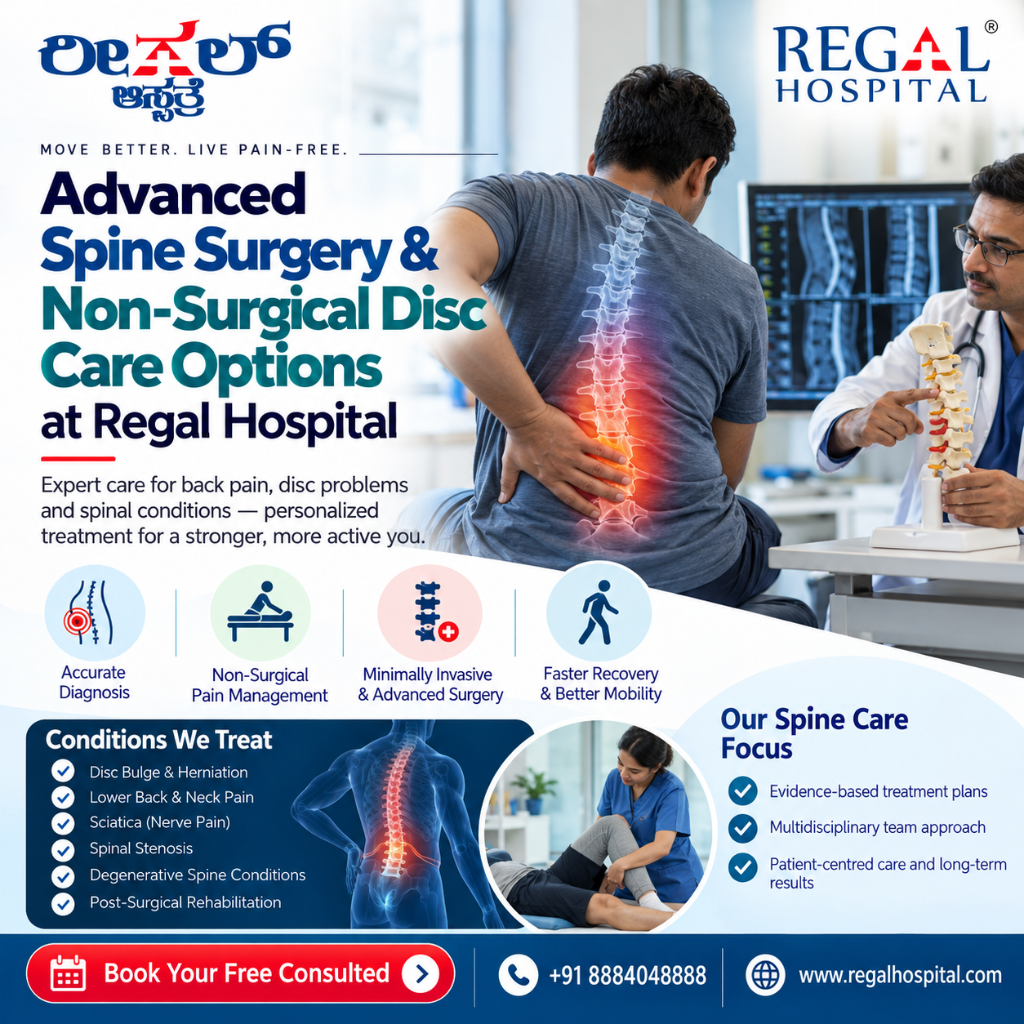
Regal Hospital is a multispecialty hospital in North Bangalore that offers neurosurgery, orthopaedics, and diagnostics. The hospital’s neurosurgery department takes care of various spinal disc problems and performs various spinal surgeries.
For patients seeking a spine care clinic at Regal Hospital, Thanisandra, Hennur, Yelahanka, Hebbal, or Tirumanahalli, it may ease the consultation process to know some of the treatment options available.
What Is a Spinal Disc Problem?
The backbone or spine consists of a series of vertebrae, and separating each vertebra is an intervertebral disc. The discs allow the spine to move and help absorb shock.
A disc can bulge, tear, or herniate. If a disc herniates, the disc may irritate or compress a nearby nerve.
Depending on the location of the disc problem and how severe it is, it may cause pain in the neck or back and may lead to symptoms in an arm or leg.
Not all disc problems need surgery. The best treatment option depends on the patient’s symptoms, physical exam, and results of imaging studies and response to non-operative treatment.
Common Symptoms of Disc Conditions
Symptoms depend on the area of the spine that is affected.
Symptoms of Lumbar Disc Conditions
Patients may have the following symptoms:
– Pain in the low back, buttock, or leg
-Pain that may be made worse with certain movements
-Pain that is in the leg and feels like “pins and needles” or numbness
-Weakness in the leg
-Inability to perform certain movements or long periods of sitting may make symptoms worse.
Symptoms of Cervical Disc Conditions
Patients may have:
-Pain and stiffness in the neck
– Referred pain to the shoulder, arm, and/or hand
-Numbness or “pins and needles” in the arm or hand
-Muscle weakness in the arm
– Nausea, vomiting, and headaches may occur if there is compression of the nerves in the upper back or neck.
Conditions causing herniated discs may be due to multiple factors.
-Aging can cause discs to be more brittle, which may increase the risk of tearing or herniating.
-Poor posture, repetitive actions, and a sedentary lifestyle may contribute to the development of herniated discs.
-Sudden injuries and heavy lifting may also play a role in herniating discs.
Body Weight and Lifestyle
Excess body weight can increase the mechanical load on the spine. Regular physical activity and maintaining an appropriate body weight are essential for the health of the musculoskeletal system.
When Should You See a Spine Specialist?
Back pain is normal and can resolve with rest. Pain relief should not last long. A doctor should be consulted if the pain does not resolve, is persistent, or returns. Back pain should always be addressed if it causes lack of function or prevents normal activities.
You should seek immediate medical attention if you have back or neck pain with:
-Progressive weakness, numbness
-Lack of control over bladder or bowel function
-Difficulty walking
-Numbness in groin and inner thighs
How Are Spine Problems Diagnosed?
A spine evaluation typically includes a thorough medical history and physical examination. The evaluation may include assessments of range of motion, muscle strength and tone, reflexes, sensory testing, and other neurologic findings.
Imaging Tests
Images of the spine and the structures adjacent to the spine may be obtained to confirm or exclude a clinical diagnosis.
Depending on the clinical picture, the following may be ordered:
X-rays
-Computed Tomography (CT) scan
-Magnetic Resonance Imaging (MRI)
Regal Hospital is equipped to perform MRI and CT scans and interpret the images. In addition, Regal Hospital has musculoskeletal radiology services.
If abnormalities of the spinal discs are noted on MRI or CT, this does not warrant an immediate surgery. Often, other non-operative care and conservative treatment are the initial, first-line management options.
Treatment
Depending on the diagnosis, your doctor may prescribe some medicines to manage your pain or other symptoms related to muscles or inflammation. The medicines should be taken only after consultation with a doctor.
Physiotherapy and Exercise
A structured physiotherapy program can improve your flexibility and muscle strength and normalize your posture and movement. The exercises should be prescribed considering your condition and not copied from a general program available on the internet.
Activity and Ergonomic Changes
Improving your sitting posture and working position, changing your lifting technique, and gradually returning to normal physical activity may be helpful for you.
Lifestyle Measures
The spine-related problems may be worsened by being overweight, being physically inactive, and by staying in one position for a long time.
For many patients, herniated disc treatment begins with conservative methods of treatment before considering more aggressive/invasive treatments.
Advanced Spine Surgery Options
When symptoms, neurological signs, and/or radiological findings suggest nerve root compression and conservative treatment does not relieve the symptoms adequately, a surgeon may consider surgical treatment to alleviate the root compression.
Regal Hospital’s neurosurgery department describes a number of procedures for spinal conditions.
Microdiscectomy
This is a surgical treatment for selected patients with lumbar disc herniation. In this surgery, the surgeon removes the disc herniation that is compressing or irritating the nerve root.
Whether this surgery is indicated depends on the symptoms of the patient, the findings of the neurological examination, and the reports of the radiological studies.
Laminectomy
This procedure involves removing the lamina of the vertebral arch to provide more space for the spinal nerves to exit the spinal canal. This surgery may be indicated for selected conditions like narrowing of the spinal canal and compression of the nerves.
Spinal Fusion
This surgery fuses a portion of the spine with the goal of improving pain and/or stability. The use of spinal fusion surgery may be considered for some structural or degenerative conditions of the spine when other treatment options have not been effective or are not appropriate.
Regal Hospital’s orthopedics service lists a number of spinal procedures, including discectomy, foraminotomy, laminectomy, and spinal fusion.
There is no single treatment that is appropriate for every patient.
A specialist may consider:
-How long the patient has had symptoms
-Severity of the patient’s symptoms
-Whether the patient has evidence of nerve compression
-Whether the patient has any muscle weakness/wastage or sensory changes
-Results of the patient’s MRI and other imaging
-Previously treated the patient has received
-The patient’s overall health
-How active the patient is
The treatment for a patient with nerve compression and evidence of neurological changes may be different to that of a patient with a disc abnormality and no neurological symptoms.
The goal of treatment is to improve the patient’s clinical condition.
Recovery After Treatment
The expected length of recovery varies depending on the condition of the patient and treatment received.
After non-surgical treatment, patients may gradually resume their normal activities, with the guidance of their treating team.
Patients may be given restrictions on their activities after spinal surgery and may be required to perform exercises as part of their recovery. It is important for patients to follow the instructions of the treating team and not to compare their recovery to that of others.
What can you do for your long-term spine health?
-Maintain a healthy body weight
-Strengthen your core and back muscles
-Use good posture.
-Take breaks from sitting and move around.
-Learn how to lift safely
-Stay active within your physical limits.
Why Consider Regal Hospital for Spine Care in Bangalore?
Regal Hospital is a North Bangalore multispecialty hospital with neurosurgery and orthopedic services. The neurosurgery department has information about spinal disc disorders and lists various spine procedures.
Other medical services offered by the hospital, such as emergency services, ICU, diagnostics, and other specialties, can be helpful if the patient requires a combination of services.
Located at Tirumanahalli on Chokkanahalli Hegdenagar Main Road, Regal Hospital services patients from north Bangalore, including Thanisandra, Hennur, Yelahanka, and Hebbal.
Patients may come to Regal Hospital for World Spine Day Bangalore resources or for other urological services provided by the hospital; however, for any concerns relating to the spine, it is always recommended to consult an appropriate neurosurgery or orthopaedic specialist.
Frequently Asked Questions
- Does every herniated disc require surgery?
No. Many disc problems can initially be managed with appropriate medicines, activity modification, physiotherapy, and other conservative measures. Surgery may be considered when symptoms persist or when there is significant nerve compression or neurological impairment.
- What is the difference between a slipped disc and a herniated disc?
“Slipped disc” is a commonly used term, but the disc does not literally slip out of position. A herniated disc refers to disc material extending beyond its normal boundary and potentially irritating or compressing a nerve.
- When is spine surgery considered?
Surgery may be considered when conservative treatment has not adequately controlled symptoms, or when there is significant nerve compression, progressive neurological weakness or another structural condition requiring surgical treatment. A specialist assessment is necessary.
- Can back pain improve without surgery?
Yes. Depending on its cause, many types of back pain can improve with appropriate non-surgical treatment, physical rehabilitation, activity modification and time. The correct approach depends on the underlying condition.
- How can I protect my spine in everyday life?
Regular appropriate exercise, good posture, safe lifting techniques, healthy body weight and avoiding prolonged sitting can support spine health. If you have persistent or recurrent pain, consult a qualified specialist rather than relying only on self-treatment.
Book Your Spine Assessment at Regal Hospital
If persistent back or neck pain is affecting your daily life, an early specialist assessment can help identify the underlying problem and discuss suitable treatment options.
For patients seeking spine care clinic Regal Hospital services in North Bangalore, the hospital provides access to neurosurgical and orthopaedic care within a multispecialty setting. Regal Hospital+1
Book Your Free Consultation Today
 Call us today: +91 888 405 8888.
 Visit us: Near Thanisandra-Yelahanka Road, Bengaluru
 Learn more: www.regalhospital.com
This blog is for educational purposes only and should not replace medical advice from a qualified doctor. Please consult a specialist for diagnosis and treatment.