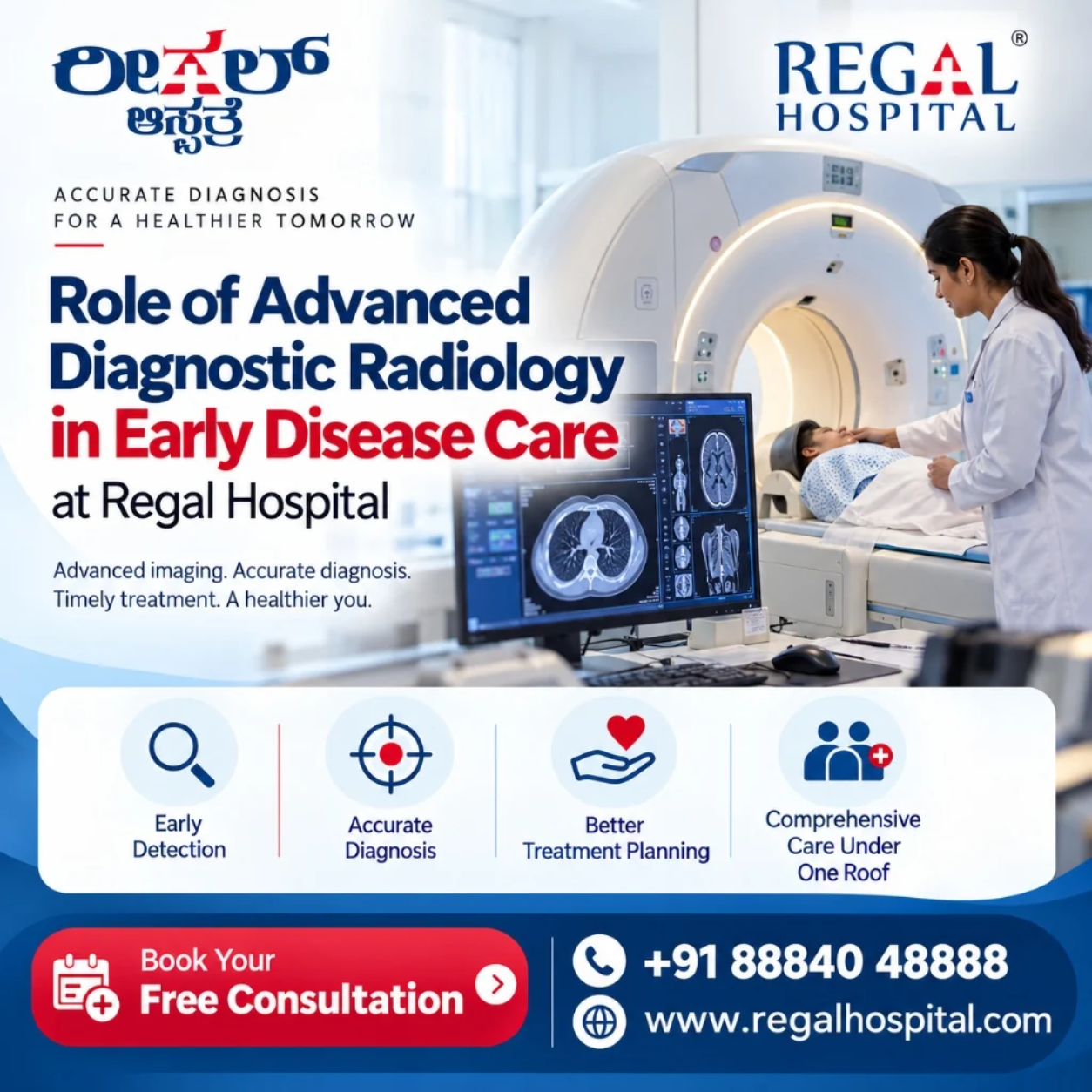
Introduction:
Eearly diagnosis of a health condition can help in properly managing it. There are various health conditions including urinary tract infections and problems like kidney stones, and several others like injuries to the bones or disorders of the abdomen. Identification of the root cause of symptoms helps the doctor suggest the appropriate treatment.
Patients in Bangalore looking for a radiology center can access diagnostic tests and get professional interpretations to make timely and appropriate medical decisions. Doctors use various imaging tests to check the internal structures of the body and also assist them in diagnosis based on symptoms and physical examination.
Regal Hospital in Tirumanahalli near Thanisandra, North Bangalore, has diagnostic imaging facilities like X-ray and ultrasonography, along with other related CT services, and provides specialized medical care. Its radiology services assist in assessment of various conditions involving the kidneys and urinary tract.
Patients living in Thanisandra, Hennur, Yelahanka, Hebbal and the surrounding areas can learn about the basics of diagnostic radiology to prepare for their medical consultation and help make more informed decisions about their health.
What is diagnostic radiology?
Diagnostic radiology is a specialty in which doctors use various imaging techniques to help in the diagnosis of conditions.
Depending on the case, doctor may recommend X-ray, ultrasound, CT scan or MRI. Each of these test provide different information and help in answering different clinical questions.
How does Radiology help in Early Detection of Diseases?
Diagnostic Imaging helps the Doctor:
To identify any abnormalities present in the body which may not be clinically apparent.
Evaluate the size, location and extent of the condition present.
Investigate any symptoms for which no apparent clinical cause has been found.
Select appropriate biopsy and drainage procedures.
Monitor for changes during treatment and/or during follow-up.
Imaging may not be able to diagnose or detect all diseases. Your doctor may use other examinations (such as a blood test or urine test), in addition to diagnostic imaging services.
Common Diagnostic Imaging Services
Patients interested in CT scan and MRI services in and around Thanisandra, should know that different imaging services are for different purposes. A doctor may best determine the right test.
- Ultrasound Imaging
As a form of diagnostic imaging, ultrasound uses sound waves to produce images of internal body parts. It does not make use of ionizing radiation. Ultrasound is most commonly used for imaging the organs of the abdomen and pelvis.
For example, to determine the presence of kidney stones, a KUB ultrasound may be performed, in addition to other assessments, to determine obstructions and abnormalities of the urinary system.
Painless, ultrasound may be slightly uncomfortable due to pressure applied by the transducer.
- CT Scan
A CT scan produces images of the body using X-rays and a computer.
In the case of suspected kidney stones, for example, a non-contrast CT scan may be performed to determine the presence, location, and size of stones. CT scans may also be performed to assess for injuries and conditions of the lungs and other abdominal organs.
Though a quick test, a CT scan makes use of ionizing radiation and therefore, a doctor would weigh the benefits vs. risks for children, pregnant patients, and others who may require repeated tests.
- MRI Scan
MRI does not make use of ionising radiation, instead, it uses a strong magnetic field and radio waves.
It is very useful in the evaluation of conditions involving the brain, spine, joints, and some abdominal organs. An MRI may be performed when other investigations have not provided sufficient information to address a clinical concern.
Prior to an MRI, patients are required to inform the imaging team of any implanted devices (e.g. pacemakers, ICDs, AICDs, neurostimulators) or metallic fragments, as they may affect the integrity of the magnetic field and/or beam. The use of contrast material during an MRI is determined by the indication, and the patient’s medical history.
- X-Ray Imaging
Chest conditions, joint and fracture problems may be assessed with x-rays. Certain abdominal and urinary conditions may also be assessed with x-rays.
X-rays are quick and may be used initially to assess a patient. However, x-rays may not always assess kidney stones, and therefore a CT or ultrasound may be more appropriate in assessing kidney stones.
Kidney Stones and Their Symptoms
Kidney stones are hard deposits made up of minerals and salts that have crystallized in urine. Stones may remain in the kidney or move to the ureter where they can obstruct the flow of urine. Stones may be small enough to pass through the ureter. Larger stones or stones that cause obstruction may require medical attention.
The location and size of a kidney stone may cause different symptoms. Symptoms may include: a sharp pain in the side or back that may extend to the groin or lower abdomen, blood in the urine that may be pink, brown or red, frequent, urgent, or painful urination, nausea or vomiting.
Cloudy or foul smelling urine in the presence of an infection.
Rarely, kidney stones are detected incidentally on imaging performed for unrelated reasons.
Causes and Risk Factors
Kidney stones are formed when urine is too concentrated and allows crystallization of mineral deposits. Conditions associated with high and low urine volumes, high salt diet, certain metabolic conditions, family history, and obesity increase the risk for kidney stone formation.
Since risk factors vary for each individual, the best advice on dietary changes and fluid intake is individualized.
When does kidney stone pain require urgent care?
Urgent care is needed for the following symptoms: Persistent or severe back pain; fever or chills; repeated vomiting; blood in the urine; or inability to pass urine.
Obstruction of the urinary tract by a kidney stone with an infection can be a medical emergency. It is best not to wait for the symptoms to improve and for the infection to clear before seeking medical help.
Regal Hospital offers 24/7 emergency care as well as specialized care. If your condition is serious, do not delay in seeking emergency medical care.
How is a kidney stone diagnosed?
A thorough evaluation by the doctor helps the doctor select the best treatment option. Diagnostic tests include:
Urine and Blood tests: to look for blood, infection and stone forming chemicals
Ultrasound and CT scans: to locate the stones
Stone Analysis: to determine the stone composition
The choice of the diagnostic tests is individualized depending on the symptoms, other clinical conditions, and pregnancy.
Options for Treatment of Kidney Stones in Bangalore
The course of treatment depends on the size and the location of the kidney stone, the degree of obstruction it creates, if any, and the effect it has on the flow of urine. Patients looking for treatment options for kidney stones in Bangalore should consult an urologist instead of taking scan results in isolation.
Medical Treatment and Observation
Small kidney stones may pass on their own. Pain relievers and medicines to aid in the passage of stones may be prescribed. Selected uric acid stones may be dissolved through medically supervised treatment.
Lifestyle Modification and Prevention
Some kidney stones may be prevented by adequate hydration, maintaining a low sodium diet, and making modifications to your dietary intake. Fluid intake and diet modifications may be individualized based on the patients’ condition.
Treatment of Kidney Stones
Extracorporeal shock wave lithotripsy (ESWL) is a non-invasive procedure to break kidney stones into smaller fragments.
For stones located in the ureter, a procedure called ureteroscopy may be done by first gaining access to the stone through the urinary tract and then breaking the stone using a laser.
Clinical findings may be used to decide the best treatment course for the kidney stones.
Surgery for Large or Complex Stones
For large or complex kidney stones, a procedure called percutaneous nephrolithotomy (PCNL) may be done through a small back incision.
Expectations from the Treatment, Risks, and Alternatives
Patients seeking kidney stone treatment in Bangalore should be provided an understanding of expected benefits, potential risks, the recovery period, and available alternatives by the urologist prior to the procedure.
Recovery and Prevention of Kidney Stones
Patients are advised to take medications as prescribed and follow-up as scheduled after treatment.
Follow your doctor’s advice regarding the quantity of fluids you consume to prevent kidney stones.
Maintain healthy eating habits and lower your salt intake.
Attend the recommended blood and urine tests.
Ask if a stone analysis or a 24 hour urine collection is needed.
Tell your health care team about any new symptoms, fevers, urinary problems or pain.
It is important for patients to know that the removal of kidney stones does not always prevent further stone formation. The goal is to determine the reason for stone formation to prevent further stone formation.
Why Regal Hospital for Diagnostic Imaging in Bangalore?
Regal Hospital is a multispecialty hospital and kidney care center in North Bangalore. The published facilities include X-ray, Doppler ultrasound and CT scan. The hospital interprets CT and MRI scans and performs image-guided diagnostic procedures.
The goal of the diagnostics at Regal hospital is to evaluate patients along with the treating physicians. A wide range of specialties including urology and nephrology are involved based on the patient’s condition.
The hospital is located at No. 30, CMR Complex, Chokkanahalli Hegdenagar Main Road, Devin Paradise Enclave, Tirumanahalli, Bengaluru, Karnataka 560064.
The hospital is easily approachable for patients residing in Thanisandra, Hennur, Hebbal, Yelahanka and surrounding areas of North Bangalore.
Before planning a visit for diagnostic tests at the hospital, contact the hospital to find out if the tests are available, what kind of preparations (if any) are required, what time to arrive, and other important instructions.
Frequently Asked Questions
- Why is diagnostic radiology important for early disease care?
Diagnostic radiology helps doctors examine internal organs and tissues, identify abnormalities, investigate symptoms, and monitor certain conditions. The findings are interpreted alongside clinical assessments and other tests.
- Which scan is best for detecting kidney stones?
Ultrasound and non-contrast CT are commonly used. CT can provide detailed information about stone size and location, while ultrasound avoids ionising radiation. Your doctor will recommend the most suitable test.
- Can I get CT scan and MRI services near Thanisandra?
Regal Hospital publishes radiology services and information on CT and MRI interpretation. Contact the hospital directly to confirm which scan services are currently available, whether an appointment is needed, and how to prepare.
- Is a CT scan safe?
CT scans use ionising radiation. When medically indicated, the expected diagnostic benefit generally outweighs the potential risk. Your doctor will consider your age, pregnancy status, medical history, and the need for repeat scans.
- Does every kidney stone require surgery?
No. Some small stones pass naturally with observation and appropriate medical management. Larger stones, persistent symptoms, obstruction, or complications may require a procedure. A urologist can advise based on your individual assessment.
Book Your Free Consultation Today
 Call us today: +91 888 405 8888.
 Visit us: Near Thanisandra-Yelahanka Road, Bengaluru
 Learn more: www.regalhospital.com
This blog is for educational purposes only and should not replace medical advice from a qualified doctor. Please consult a specialist for diagnosis and treatment.