Introduction:
Recovering from something that makes it hard to move can make simple tasks seem almost impossible. Getting back to regular activities, like returning to work, may take some time and practice. Occupational therapy helps people restore their independence and their ability to participate in everyday living.
If you’re looking for occupational therapy in Bangalore, the first step is understanding the differences in rehabilitation services and the supports available.
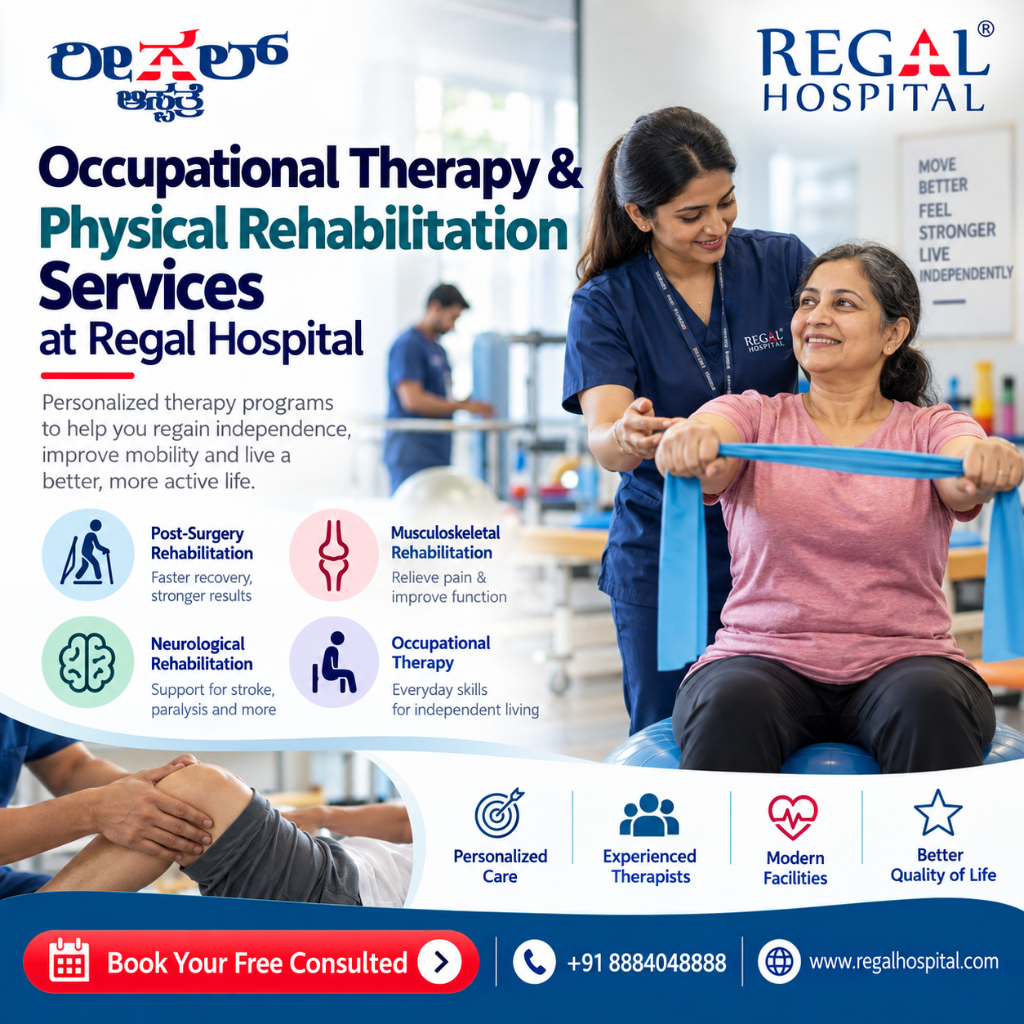
Regal Hospital is a multidisciplinary hospital in Tirumanahalli, North Bangalore, that provides neurological and orthopaedic rehabilitation, paediatric and geriatric rehabilitation services, as well as cardiopulmonary rehabilitation. For occupational therapy, you’re advised to contact the hospital for availability of services and to discuss your rehabilitation needs.
Those living in Thanisandra, Hennur, Yelahanka, Hebbal and Tirumanahalli can consider a rehabilitation plan to help them recuperate faster.
What is Occupational Therapy?
In occupational therapy, ‘occupation’ refers to everyday activities, and the goal of therapy is to help people perform these tasks by themselves.
In occupational therapy, the focus is on how an individual’s health, mental skills, coordination, and environment affect his/her everyday activities. The therapist will work to achieve the goal with the help of various therapies and activities.
Depending on the needs of the individual, occupational therapy may include:
- Activities of Daily Living (ADLs) like bathing, dressing and grooming.
- Eating and cooking.
- Fine motor skills.
- Remembering information and organizing your day-to-day schedule.
- Safely moving about and participating at home, school, or work.
- Using and/or modifying home equipment and/or environment to best suit your needs.
It is individualized and the goal is to help you be as active as possible in your community and social environments based on your skills and limits.
Physical Rehabilitation
The goal of physical rehabilitation is improving the way you move by increasing your strength, flexibility, balance, and endurance.
This often includes treatment and/or management by a physical therapist, who can prescribe a specialized exercise program, mobility training and other techniques to increase movement and function.
While the focus of occupational therapy is performing daily activities, the focus of physical therapy is moving and functioning. The two approaches complement each other.
At a multispecialty hospital, rehabilitation is often integrated with other specialties to best address your medical diagnosis and recovery.
Stroke patients can be great candidates for occupational therapy. Often, there is a lot of variability in how people are affected by a stroke, and what functions and movements are affected. This may include balance, muscle strength, memory, speech, sensation, or the use of one side of the body.
In addition to therapy to relearn walking or transfers, stroke rehabilitation may include other activities to train the affected limbs and instruct patients in techniques to perform activities of daily living (ADLs), such as eating or dressing.
Families seeking stroke rehab Thanisandra should look for a care plan based on the patient’s abilities, medical stability, and recovery goals. Rehabilitation should commence at the recommendation of the patient’s medical team.
- Recovery after Surgery or Orthopaedic Injury
Joint replacements, fractures, arthritis and other musculoskeletal conditions can inhibit the ability to walk or grip and can limit the performance of household tasks.
Rehabilitation can improve movement and strength of joints and may help in the performance of household tasks based on the instructions of the treating clinician. Occupational therapy may aid the patient in performing the activities of daily living and in recovering from the disruptions in their routine.
- Neurological Conditions
Stroke, brain and spinal cord injuries, injury or disease of the nerves can alter movement, balance, sensation and cognitive functions. Rehabilitation goals may include improving the ability to perform daily activities and movements involving the hands, transfers, and maintaining balance.
A rehabilitation program is developed based on the individual’s abilities and the condition.
- Older Adults and Children
Weakness and reduced mobility may lead to dependency on others for care and assistance with activities of daily living. Older adults and children may benefit from rehabilitation when they have disruptions in routine activities due to a loss of functional ability, or if they develop conditions that alter their ability to participate in school and family activities.
A rehabilitation program is aimed at restoring functional ability and improving balance and mobility to maximize an individual’s level of independence in activity and movement. What Happens during a Rehabilitation Assessment?
A rehabilitation assessment is conducted to understand the patient’s goals, limitations, and health condition.
Balance and ability to walk, or transfer to, a wheeled chair.
Use of the hands and ability to perform activities of daily living.
Ability to perform ADLs safely, including endurance, attention, and other functional skills.
What is the level of support required at home, at work, and with the family?
The therapy team then sets appropriate goals and plans interventions. Examples of goals and interventions may include improvement in bed to chair transfer, use of walking aid, use of the hands, or performing ADLs with less assistance.
In the rehabilitation process, the progress of the patient is monitored and treatment goals and interventions are modified according to the patient’s response.
Rehabilitation treatments may include various therapies based on the patient’s condition and levels of function and disability.
Some of the therapies may include:
Mobility training and practice
To improve strength, flexibility, movement, balance, and coordination, and practice walking.
Functional task training
The patient practices real life activities, i.e. cooking, dressing, performing household chores, etc. The activities are practiced according to the need and safety of the individual.
Neurological rehabilitation
For improvement in balance, movement, coordination and to practice performing activities of daily living based on the condition of the patient.
Adaptive equipment
Training and use of special aids and equipment for performing daily activities.
Home exercise
The therapist may teach the patient and/ or family members how to perform the exercises to regain movement and functions at home under supervision and according to professional instruction.
Why Consider Regal Hospital for Physical Rehabilitation?
Physical Therapy services are provided at Regal Hospital, North Bangalore, for orthopedic, neurological, paediatric, geriatric and cardiopulmonary conditions, among others. The hospital website describes a multi-specialty center comprising of medical, diagnostic and hospital services.
This is applicable to cases where the patient requires physical rehabilitation services and concurrent management of other medical conditions. The physiotherapy team at Regal Hospital formulates treatment plans by considering the patient’s condition and clinical diagnosis.
If a physical rehabilitation center is being considered, Regal Hospital location at Tirumanshalli may be helpful for patients living in North Bangalore (Thanisandra, Hennur, Yelahanka, Hebbal and other surrounding areas).
When making a booking, ask about the availability of occupational therapy, what services are provided, what will be the cost, if a referral is needed and what assessments are to be done. These are pertinent questions, considering that physical and occupational therapy are separate services, and should be confirmed with the hospital directly.
Tips for Maximizing Rehabilitation
Beyond the sessions scheduled by the rehabilitation team, additional practice at home may be beneficial to reach treatment goals. Various strategies may help patients and their families safely implement the care plan at home:
Attend all recommended appointments with the treating team.
Practice only activities/exercises approved for your condition by your rehabilitation team.
Keep your home free of tripping hazards.
If instructed, use the mobility aids as prescribed.
Tell your rehab team if your pain/fatigue/balance/function has changed.
Set realistic goals, and be aware of/appreciative of small changes or improvements.
Teach caregivers how to assist you safely by learning techniques from the rehabilitation team.
Recovery depends on numerous factors like the condition, the level of condition/health, and how consistently a patient participates in rehabilitation. No particular outcome or recovery is assured.
Frequently Asked Questions
- What is the difference between occupational therapy and physiotherapy?
Occupational therapy focuses on helping people perform everyday activities, while physiotherapy generally focuses on movement, strength, balance and physical function. Some patients benefit from both.
- Can rehabilitation help after a stroke?
Yes. Stroke rehabilitation may help eligible patients practise movement, balance and daily activities. The programme depends on the effects of the stroke, medical stability and individual goals.
- When should someone start rehabilitation after surgery?
The timing depends on the operation, the patient’s condition and the surgeon’s instructions. Some programmes begin early, while others require a period of protection or restricted movement.
- Is occupational therapy available at Regal Hospital?
Regal Hospital lists physiotherapy and several rehabilitation-related services on its website. Contact the hospital directly to confirm current occupational therapy availability and the services suitable for your needs.
- Where can I enquire about rehabilitation in North Bangalore?
Regal Hospital is located in Tirumanahalli, North Bangalore. Patients from Thanisandra, Hennur, Yelahanka, Hebbal and surrounding areas can contact the hospital to enquire about physiotherapy, rehabilitation assessments and appointment availability.
Book Your Free Consultation Today
 Call us today: +91 888 405 8888.
 Visit us: Near Thanisandra-Yelahanka Road, Bengaluru
 Learn more: www.regalhospital.com
This blog is for educational purposes only and should not replace medical advice from a qualified doctor. Please consult a specialist for diagnosis and treatment.