Introduction:
There are various reasons for the development of blood clots in veins and certain conditions may necessitate immediate medical attention. One of these conditions is Deep Vein Thrombosis (DVT) where a blood clot forms in a deep vein, usually in the leg.
For individuals looking for DVT treatment in Bangalore, identifying symptoms, risk factors and treatment options may assist in timely medical intervention.
Regal Hospital is a multispecialty facility in North Bangalore offering 24×7 Vascular, Radiology and A & E services. This enables patients to get rapid assessment and specialised care, when required.
What Is Deep Vein Thrombosis?
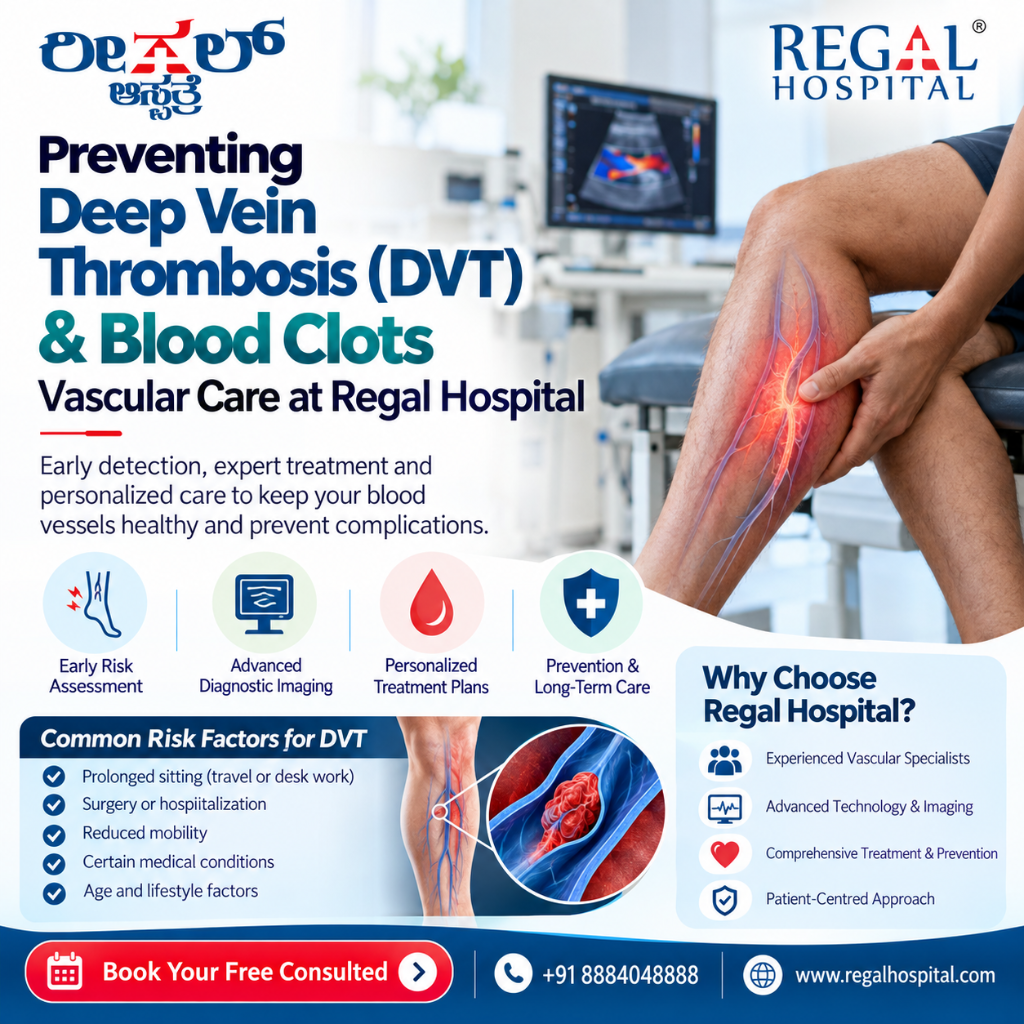
Deep vein thrombosis is a condition where a blood clot forms in a deep vein usually in the lower limb.
Some individuals may not experience any symptoms with DVT and a clot may break off and reach the lung causing a condition called pulmonary embolism.
It is important to note that DVT requires evaluation by a medical professional and self-medication should be avoided.
Common Symptoms of DVT
Symptoms of DVT include:
– Swelling in a limb
-Pain or tenderness in a limb
– Warmth in a limb
-Changes in skin color
-Heaviness in a limb
Symptoms of DVT may also be misleading and individuals may confuse these symptoms with other conditions like muscle injuries or infections.
A medical exam will help determine the cause of the problem.
Symptoms that require immediate medical attention
If leg symptoms occur with any of the following, seek emergency medical attention:
-Sudden shortness of breath
-Chest pain, especially with deep breathing
-Coughing up blood
-Rapid heart rate
-Fainting or severe lightheadedness
Pulmonary embolism can cause these symptoms and should not be evaluated at home.
What Causes Blood Clots?
There are three main things that can lead to the formation of blood clots.
-Decreased blood flow
-Increased clotting of the blood
-Altered conditions of the blood vessels
Common risk factors for DVT
Risk factors can include:
-Long periods of sitting or lying in bed
-Recovering from major surgery
-Hospitalization
-Long, uncomfortable trips with little to no movement
-Previous experience with DVT
-Some cancers
-Pregnancy and the postpartum period
-Some inherited and acquired disorders that affect clotting
-Use of certain medicines that contain hormones
-Increased age
-Being overweight
-Some chronic medical conditions
Having a risk factor doesn’t mean DVT will occur for sure. Having multiple risk factors increases the chance for a person to develop DVT. Prevention may be discussed with a healthcare provider.
How is DVT Diagnosed?
The healthcare provider may assess symptoms and risk factors before making the decision to do any tests.
To evaluate blood flow and look for blood clots, Doppler ultrasound may be used.
Other tests may include a blood test to see if there is a D-dimer present. This isn’t a definitive test for DVT, though.
In specific cases, more tests may be required.
Regal Hospital’s Diagnostic Services include Doppler and Vascular Imaging, while its Radiology Department includes Diagnostic Imaging.
DVT Treatment Options
Depending on certain aspects such as the location and the extent of the clot, the symptoms, the risk of bleeding, the general health of the patient and the presence of any complications, patients are provided with appropriate treatment for deep vein thrombosis in Bangalore.
Anticoagulant medications
The use of anticoagulants or blood thinners helps to prevent the clot from getting bigger and also reduces the risk of the formation of new clots.
They do not immediately dissolve the clot. With the help of these medications, the body gradually breaks the clot.
Because of the increased risk of bleeding with the use of anticoagulants, they should be taken only under the supervision of a physician.
Compression therapy
In selected patients, swelling and related symptoms of the leg can be managed with the use of compression stockings. They should be used only with the advice of a health care professional.
Thrombolytic treatment
In selected cases of extensive or limb-threatening thrombosis, the use of medications which help to dissolve clots may be considered. But the use of such medications is not without risks of bleeding.
Vascular surgeries/procedures
There are patients with complicated vascular diseases, where an interventional or surgical approach may be required. Only a vascular surgeon can decide if such procedures are necessary.
Regal Hospital lists Vascular Surgery as a dedicated specialty covering conditions affecting the arterial, venous and lymphatic systems.
Preventing Blood Clots
The measures to prevent blood clots depend on the risk factors of an individual.
Risk management measures to reduce the risk of blood clots can be anti-coagulant medication, early mobilisation or the use of compression devices.
Discuss travel risks
Patients with a history of DVT or other significant risk factors should discuss long distance travel with their doctor before travelling.
Follow medication plans
If prescribed an anti-coagulant, take as prescribed and do not make any changes without consulting your doctor.
Related Kidney Health: Understanding Kidney Stones
Symptoms of a urinary problem can also require prompt medical attention. This section is relevant for patients interested in a multispecialty hospital in Bangalore for both vascular and urological care.
Kidney stones are hard deposits formed when the salts and minerals in the urine become concentrated.
Common symptoms
The symptoms can be:
-Sharp pain in the side or back or in the abdomen,
-Pain that moves to the groin,
-Blood in the urine,
-Burning or discomfort while passing urine,
-Frequency of passing urine,
-Nausea or vomiting
When do kidney stone symptoms become an emergency?
Urgent medical attention should be sought when the symptoms are accompanied by vomiting, fever, blood in the urine, pain in the kidneys, inability to pass urine, or other symptoms of urinary tract infection.
Regal Hospital has a urology department and 24 hour A and E services.
MEDICATION AND OBSERVATION
In selected cases, a urologist may recommend observation, pain relief, and/or medicine. Small stones may pass on their own.
ESWL
At Regal Hospital, ESWL is one of the kidney stone treatment options. ESWL uses shock waves to break stones into smaller fragments.
URETEROSCOPY AND LASER TREATMENT
During a ureteroscopy, a thin scope is passed through the urinary tract to reach a stone. Once there, laser energy can be used to break stones into smaller fragments.
LARGER OR COMPLEX STONES
For treatment, a urologist reviews the size and location of the stones, and the overall health of the individual. Larger and more complex stones may require a procedure like percutaneous nephrolithotomy (PCNL).
For kidney stone treatment in Bangalore, Regal Hospital’s Urology Services reviews and provides several treatment options.
RECOVERY AND PREVENTION
AFTER TREATMENT
This content is called out here because of its placement in the original.
How long it takes to recover from DVT is dependent on how extensive the clot was and what kind of treatment it received. It’s important that patients go to follow-up appointments and take their medicines as prescribed.
Anticoagulant therapy requires that patients inform their doctor if they experience any abnormal bleeding and if they start any new medicines.
For prevention of kidney stones some patients may undergo some changes in their diet and hydration status as well as testing. Individualized fluid needs, especially for patients with heart or kidney problems, should be considered.
Why Choose Regal Hospital For Vascular Care?
Regal Hospital is a multispecialty and advanced kidney-care hospital in North Bangalore. Its published specialties include Vascular Surgery, Urology and Nephrology, as well as Accident & Emergency Services.
R For patients needing vascular surgery from Thanisandra and other areas in North Bangalore, Regal Hospital in Tirumanahalli is convenient for patients from Thanisandra, Hennur, Yelahanka, Hebbal and surrounding areas.
Its multispecialty model can work well if a patient needs concurrent vascular evaluation and/or treatment along with other specialties.
Patients in need of DVT treatment in Bangalore should see an appropriate vascular specialist for evaluation and treatment.
Frequently Asked Questions
- What are the common symptoms of DVT?
Answer: DVT may cause swelling, pain or tenderness, warmth and skin-colour changes in one leg. Some people may have few or no obvious symptoms, so people with significant risk factors should discuss concerns with a doctor.
- Is DVT treatable?
Answer: Yes. DVT is medically treatable. Anticoagulants are commonly used, while selected patients with extensive or complicated clots may require additional treatments. The appropriate approach depends on the individual’s condition.
- When should DVT symptoms be treated as an emergency?
Answer: Sudden shortness of breath, chest pain, coughing up blood, fainting or severe dizziness alongside possible DVT symptoms requires emergency medical attention because these may indicate a pulmonary embolism.
- How is DVT diagnosed?
Answer: Doctors may use a clinical assessment, D-dimer blood testing in selected cases and Doppler ultrasound. Additional imaging may be required depending on the individual situation.
- Can kidney stones cause an emergency?
Answer: Yes. Severe kidney stone pain accompanied by fever, persistent vomiting, inability to pass urine, blood in the urine or symptoms of infection requires prompt medical assessment.
Schedule a Vascular Assessment at Regal Hospital
If you have leg swelling, unexplained leg pain, or other symptoms that could indicate a blood-clotting problem, timely medical evaluation is important. A qualified vascular specialist can assess your symptoms and determine whether further testing or treatment is needed.
Book Your Free Consultation Today
 Call us today: +91 888 405 8888.
 Visit us: Near Thanisandra-Yelahanka Road, Bengaluru
 Learn more: www.regalhospital.com