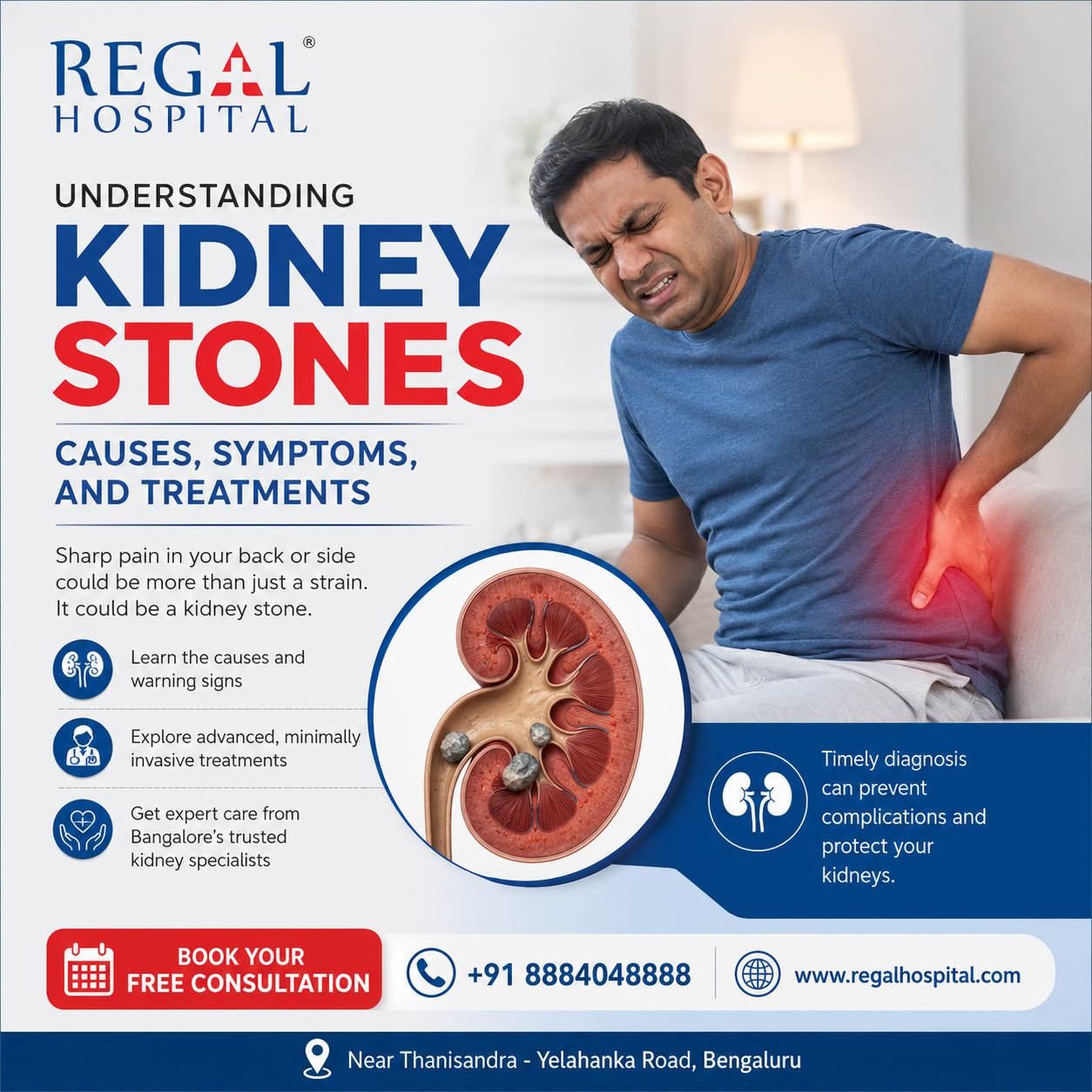
First, imagine waking up in the middle of the night. Suddenly, you feel a sharp, unbearable pain in your lower back. For many people, this intense discomfort is their very first kidney stone encounter. Naturally, the pain can be deeply frightening. Furthermore, the uncertainty makes the experience incredibly stressful for your family.
If you are going through this, take a deep breath. Truly, you are not alone. More importantly, this is a highly treatable condition. Specifically, kidney stones are incredibly common today. Because of our busy lifestyles, we often forget to drink enough water. Here at Regal Hospital in Bengaluru, we believe understanding your condition is the first step. Therefore, we have guided thousands through recovery safely. Below is an easy guide to why stones form and how to treat them.
What Exactly Are Kidney Stones?
Basically, your kidneys act as the body’s natural filtration system. Every day, they clean your blood and remove waste through urine. However, sometimes there is too much waste and not enough fluid. Consequently, waste products like calcium and uric acid stick together. Over time, they crystallize and form hard, pebble-like deposits. Specifically, these are known as kidney stones.
Interestingly, these stones range heavily in size. For example, some are tiny like sand and pass without you noticing. Conversely, others grow as large as a golf ball. As a result, they cause severe blockages and intense pain.
Common Causes: Why Do Kidney Stones Form?
Usually, kidney stones do not have a single cause. Instead, several factors increase your risk:
-
1. Dehydration: First, not drinking enough water is the most common cause. When you are dehydrated, your urine becomes highly concentrated. Consequently, minerals crystallize and clump together easily.
-
2. Dietary Factors: Next, what you eat plays a massive role. For instance, diets high in salt, sugar, and protein burden your kidneys. Specifically, a high salt intake forces your kidneys to filter more calcium.
-
3. Genetics: Also, family history heavily influences your risk. If your family gets stones, you are naturally more likely to develop them.
-
4. Medical Conditions: Finally, digestive diseases and obesity alter your digestion. Furthermore, certain medications and supplements contribute to stone formation.
Warning Signs: Symptoms You Shouldn’t Ignore
Typically, a stone will not cause symptoms until it moves into your ureter. When a stone gets stuck, it blocks urine flow. Consequently, your kidney begins to swell. Therefore, watch for these warning signs:
-
Severe, Sharp Pain: First, you may feel intense pain in your back or side. Often, it radiates down to your lower abdomen.
-
Painful Urination: Next, you might experience severe burning while passing urine.
-
Urine Changes: Also, your urine may look pink, red, or brown from blood.
-
Frequent Urge: Furthermore, you might feel a constant need to use the washroom.
-
Nausea: Additionally, the intense pain triggers an upset stomach and vomiting.
-
Fever and Chills: Finally, if an infection is present, you will develop a fever. Crucially, this is a medical emergency.
Advanced Treatment Options at Regal Hospital
Fortunately, treatment depends entirely on the size and location of the stone.
For Small Stones: First, your urologist may recommend a conservative approach. Specifically, you must drink three liters of water daily. Also, doctors prescribe medicines called alpha-blockers to relax your muscles. Thus, you pass the stone faster with less pain.
For Larger or Complex Stones: However, if a stone is too large to pass naturally, we use advanced treatments:
-
ESWL: First, this non-invasive technology uses sound waves to break stones into dust.
-
Ureteroscopy: Next, a tiny camera locates the stone inside you. Then, a laser breaks it into safe pieces.
-
PCNL: Finally, for very large stones, doctors make a tiny incision in your back to surgically remove it.
Practical Tips for Prevention
Undoubtedly, passing a stone is an experience you want to avoid repeating. Fortunately, simple lifestyle changes drastically reduce your risk:
-
Hydrate Relentlessly: First, aim for at least 3 liters of water daily.
-
Reduce Sodium: Next, cut back heavily on processed foods and salty snacks.
-
Eat Calcium: Surprisingly, dietary calcium actually prevents stones. However, avoid calcium supplements entirely.
-
Limit Oxalates: Finally, moderate your intake of spinach, beetroot, and nuts.
Take Charge of Your Kidney Health Today
In conclusion, dealing with urological issues feels overwhelming. However, you are in safe, capable hands at Regal Hospital. Conveniently located near Thanisandra-Yelahanka Road, we are a trusted name for kidney care.
Specifically, our Urology and Nephrology departments use the latest diagnostic technology. Ultimately, our experienced doctors and compassionate nurses ensure a smooth recovery. Therefore, do not leave your kidney health to chance.
 Call us today: +91 888 405 8888
 Visit us: Near Thanisandra-Yelahanka Road, Bengaluru
 Learn more: www.regalhospital.com